
How to Choose the Best Exhaust Fan for Poultry Farms in India – Operating a successful poultry farm involves a lot more than just ensuring that the birds have access to good quality food and water. Ventilation is very important for bird health, productivity, and efficiency of the poultry farm itself. In the case of India’s hot and humid weather, poultry sheds may easily become too hot and humid because of dust, carbon dioxide, and ammonia accumulation in the air.
This is when selecting the best exhaust fan for poultry farms is so important.
The appropriate poultry ventilation system will help you get rid of hot and stagnant air as well as provide the shed with new air. It will improve airflow and control temperature and humidity in the shed, making the conditions better for broilers, layers, and other poultry. But there are many exhaust fans for poultry sheds of various sizes and capacities in India.
What do you need to consider when selecting an exhaust fan for your poultry farm? In this blog, we will explore these factors.
Why Do We Need an Exhaust Fan in Our Poultry Farms?
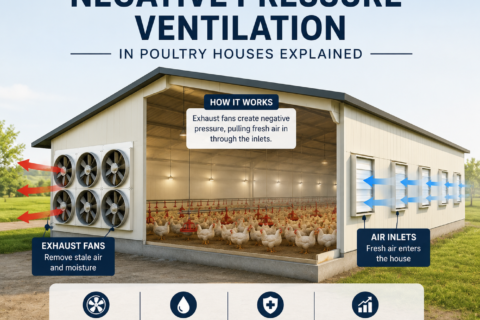
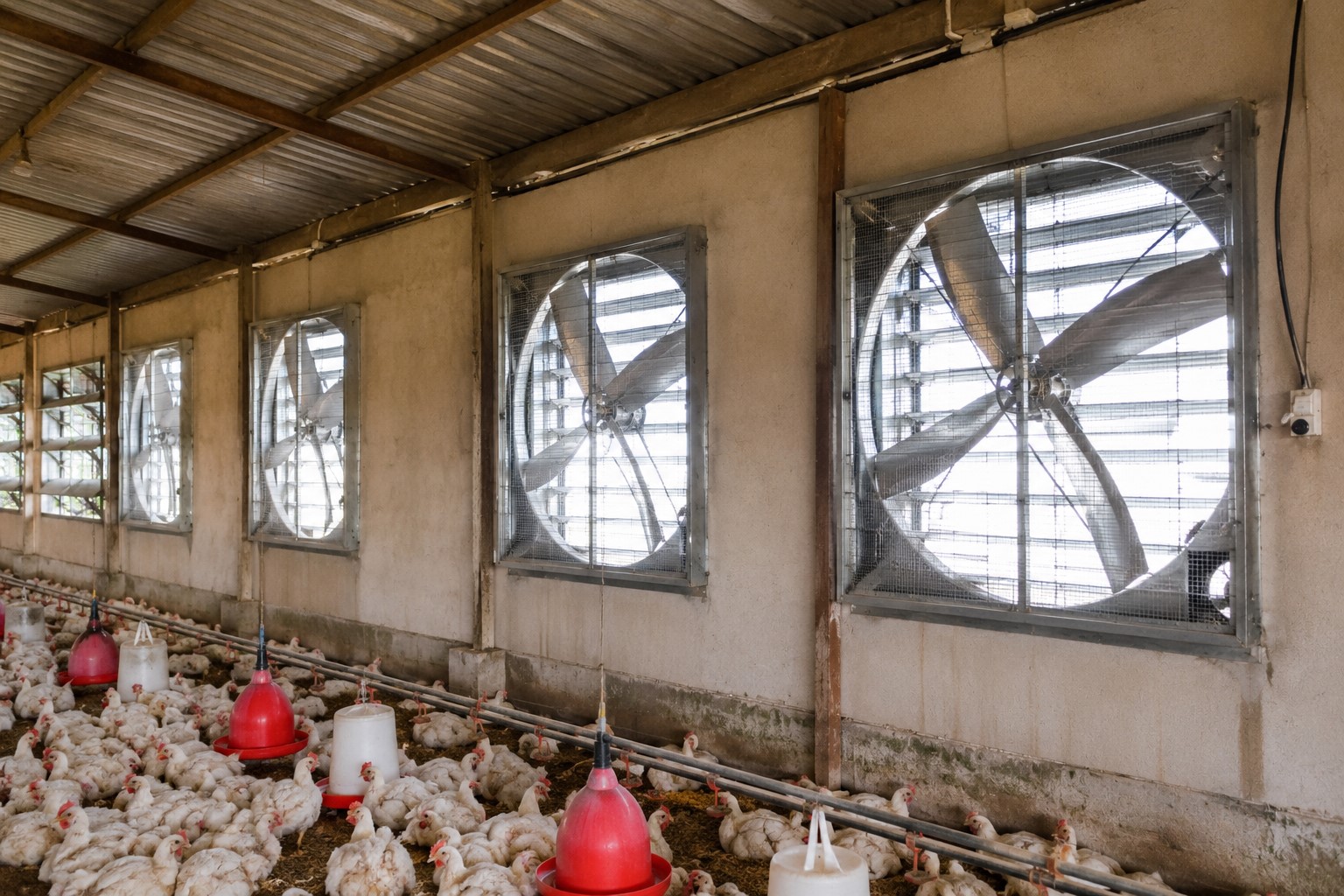
The main role of a poultry exhaust fan is to take away old, warm air from the shed and bring fresh air in its place. This is done using a negative-pressure ventilation system, where exhaust fans remove the warm indoor air, and inlets admit fresh air into the shed.
During hot and humid months in India, proper ventilation becomes crucial. Chickens are highly vulnerable to heat stress and rely mainly on air circulation and evaporation for their temperature regulation.
Things to Consider When Choosing the Best Exhaust Fan for Poultry Farms in India
1. Think About the Size of Your Poultry Shed
Before purchasing an industrial exhaust fan, measure your shed length, width, and height. The volume and surface area of the shed will help you calculate how much air you need to circulate.
If you have a small poultry shed, then you will not need many fans at all. If your shed is big and commercial, like a broiler or layer house, then you might need several large-capacity fans. It is wrong to choose a fan only because it provides a good airflow rate.
2. Consider Airflow Capacity
One of the most critical specifications is airflow capacity, which is usually stated in cubic metres per hour (m³/h) or cubic feet per minute (CFM).
While high airflow capacity is good for large sheds and tunnel ventilation, actual performance can be influenced by static pressure, fan efficiency, air inlets, and overall tightness of a chicken coop. According to a poultry ventilation reference, exhaust fans have to work in conjunction with well-designed air inlets in order to achieve an intended airflow pattern.
Thus, in assessing the best exhaust fan for a poultry farm, pay more attention not just to the CFM number, but to its performance under operating static pressure.
3. Consider Static Pressure
Static pressure is sometimes forgotten when choosing the best exhaust fan for a poultry farm, but it has a significant impact on the fan’s performance.
In a negative pressure system, the fan needs to overcome resistance coming from air inlets, shutters, screens, etc. A poultry ventilation reference mentions a typical static-pressure range of about 12–25 Pa for air entry control and airflow pattern establishment.
Do not compare fans only in terms of their free-air capacity. Always consider their performance at appropriate static pressure.
4. Selecting Energy Efficient Motors
As a poultry farm exhaust fan might run continuously for longer periods of time, especially in case of hot days, the efficiency of motors can play an important role in the overall cost of operations.
You may look for an energy-efficient motor with reliable electric components and proper speed control options. The small additional cost associated with an energy-efficient fan will be worth it in terms of low electricity consumption and reliability.
5. Checking Durable Design
The chicken house is usually full of dust, humidity, and corrosion, which can lead to the premature wear of fan components.
While comparing different industrial ventilation fans that are available in India, you need to focus on the quality of fan housing, blades, shutters, bearings, motor, and anti-corrosion protection. Cleanable components are also useful since dust and feathers can affect fan performance.
6. Think about Automation Ventilation System Control
Modern poultry houses may use a ventilation system connected to environmental controllers that control temperature, humidity, and other aspects of the shed microclimate. The system does not require using fans constantly but adjusts their work depending on the shed’s current conditions.
It helps to provide constant environmental conditions without wasting energy. For controlled poultry houses, ventilation may be controlled in three different stages, such as minimum, transition, and tunnel ventilation.
7. Remember Proper Installation and Regular Maintenance
Even the most efficient exhaust fan for a poultry farm will not be effective if it is not installed correctly. Fan installation, location of inlet, air leaks, and design of the shed itself will influence the ventilation process.
It is important to clean blades and shutters, check belts and bearings if it is necessary, check electrical connections, and ensure proper shutter functioning.
Preventive maintenance can help to maintain airflow and increase the lifespan of the equipment.
Conclusion
Selecting the right exhaust fan for poultry farms entails more than the choice between sizes and prices of fans. It involves considerations such as airflow, static pressure, motor efficiency, reliability, shed specifications, and installation process, in order to provide efficient ventilation of poultry farms.
Marut Air provides products and expertise specifically tailored to industrial and agricultural air-movement needs. Get to know more about the ventilation systems provided by Marut Air and select an appropriate one for your poultry-farm needs.
FAQs
What size exhaust fan should I get for my poultry farm?
There is no one-size-fits-all answer. It depends on the size of the shed, the number of birds, their age, climate, ventilation system, and airflow needed. It is important to do a ventilation calculation in advance to decide on the number and size of the fans.
Does a large CFM fan guarantee efficiency?
Not always. If the ventilation design of the shed and inlets do not correspond to a large airflow, a very powerful fan might not be appropriate. Operating static pressure is more significant than the CFM rating.
How many exhaust fans are needed for a poultry shed?
This will depend on the total amount of ventilation required and the capacity of each fan. Commercial poultry sheds use many fans operating in phases instead of operating all fans continuously.
Is exhaust or natural ventilation better for Indian poultry farms?
Natural ventilation will be useful in properly constructed open-sided houses, while exhaust ventilation gives you more control when conditions outside are not favorable. Indian poultry farm guides emphasize the need for good ventilation and shed design.
What factors should I consider when purchasing an exhaust fan for my poultry farm?
Look at the flow rate, static pressure performance, efficiency, construction, durability, maintenance, noise, warranty, and after-sales service. Above all, choose the right fan according to your ventilation calculation for the shed, and not just by price.