
How Poultry House Ventilation Changes Between Brooding and Market Age – Poultry House Ventilation significantly influences poultry health, growth, and overall production performance. But it must be noted that ventilation requirements for broiler chickens depend on their development stage. Chicks at birth need warm air that is not drafty, while adult chickens need air that moves fast to get rid of excess heat.
A proper understanding of ventilation in a poultry house from the brooding stage to the market age makes poultry farmers able to manage the climate, air, and chickens’ welfare properly. From minimum ventilation in the early stages up to transitional and tunnel ventilation later, everything is unique for each of them.
So, let’s find out how ventilation requirements of broilers change along with their development and what a farmer should know at each stage.
Poultry House Ventilation at the Brooding Stage
The brooding stage is one of the most sensitive stages in a broiler chicken’s life. In the first few weeks, baby chickens have poor thermoregulatory abilities and thus require a consistently warm environment with proper air supply but without excessive airflow at the chickens’ level.
The primary objective of brooding ventilation is to keep the desired temperature, and to take out extra moisture, carbon dioxide, ammonia and other gases.
Generally, a farmer uses the minimum ventilation method at this time. Fans work periodically, drawing fresh air from outside and bringing it into the poultry house via appropriately adjusted air inlets. The incoming air must flow along the ceiling, mix with the warm air inside, and reach the birds without making any cold drafts.
During brooding, it is important to consider the following points:
- Keep up with the suggested brooding temperature depending on the age of the chicks.
- Avoid cold drafts at the level of the chicks.
- Keep the relative humidity at about 50–70%.
- Get rid of excessive moisture and gases.
- Watch out for chicks’ placement and behavior to understand whether they feel uncomfortable because of temperature.
Well-organized brooding conditions motivate chicks to eat, drink, move easily, and grow.
Ventilation During Growing Period
As chicks grow, their body size and metabolism increase; they produce more heat, moisture, and carbon dioxide. That is why the ventilation system must provide the increased amounts of air gradually.
Here comes the importance of transitional ventilation.
In contrast with minimum ventilation, which aims at improving air quality without any negative effect on chicks’ comfort, transitional ventilation is concerned mainly with cooling of the farm.
Farmers can progressively turn up the fans according to indoor temperature, age of birds, stock density and weather outside.
Among other things, the goal here is to:
- Allow more fresh air to come inside.
- Eliminate any excess heat and humidity.
- Maintain good levels of humidity.
- Avoid the creation of ammonia.
- Maintain proper air circulation in the house.
The process should not be sudden. Instead, farmers should take into account bird behaviour, temperature, and environment before they increase ventilation.
Ventilation of Poultry House at Market Age
By market age, the chickens weigh more and produce far more metabolic heat than the young chicks do. At this point, they are more tolerant of cool air, but at the same time, heat stress becomes their main challenge.
This is especially true if the weather is warm and humid.
In this case, tunnel ventilation is usually used for cooling the house.
Tunnel ventilation takes in large quantities of fresh air through one end of the poultry barn and releases hot air using powerful fans from the other end, which results in fast airflow across the chickens and thus creates a wind-chill effect for them to lose body heat.
Evaporative cooling pads can also be used in hot climates to lower the temperature of the incoming air.
Some advantages of efficient market-age ventilation include:
- Releasing the stored body heat.
- Decreasing the effect of heat stress in summer.
- Improving the circulation of air across the chicken flock.
- Ensuring good indoor air quality.
- Ensuring the intake of food and growth performance.
Nevertheless, the efficiency of cooling pads is reliant on the amount of humidity in the outside air. The higher the humidity in the air, the less efficient evaporative cooling becomes.
Differences Between Brooding and Market Age Ventilation
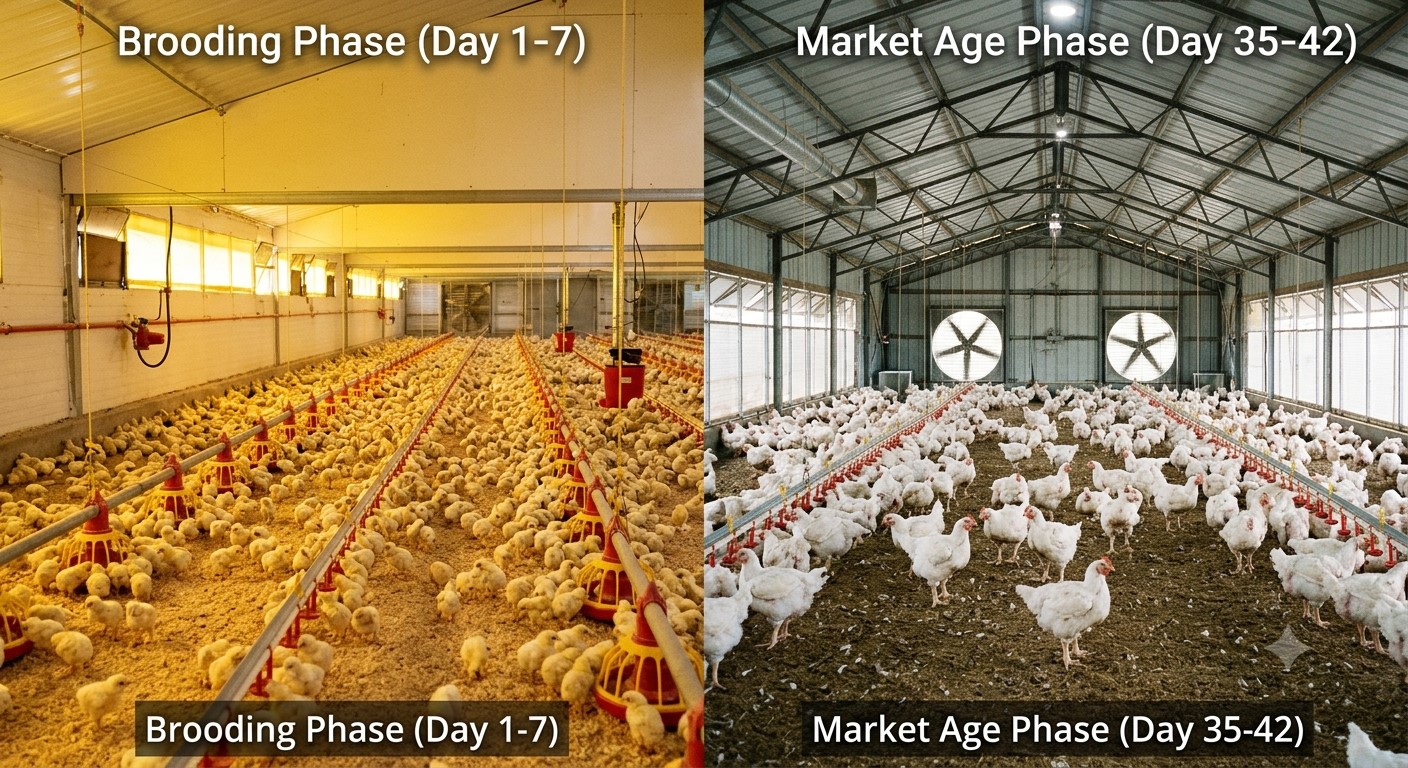
While both stages need fresh air, there is a lot of difference between the two in terms of ventilation needs.
| Parameter | Brooding Stage | Market Age |
| Main priority | Warmth and fresh air | Heat removal and cooling |
| Ventilation type | Minimum ventilation | Tunnel ventilation when required |
| Air speed | Very low at chick level | Higher airflow across birds |
| Temperature control | Requires supplemental heating | Focuses on removing excess heat |
| Air exchange | Lower, controlled rates | Higher air exchange when needed |
| Cooling system | Generally limited | Tunnel fans and cooling pads |
Heat retention and heat release are the most significant differences since brooding requires heat retention while market age needs heat release.
Why Proper Ventilation Management Is Important
Besides regulation of temperatures, a well-designed ventilation system has direct effects on the comfort of birds, quality of litter, health of the respiratory tract, and performance of the flock.
Poor ventilation creates problems like high humidity, wet litter, excess ammonia, and irritation of respiratory organs, and excessive and wrongly directed airflow in brooding period causes cold areas and higher requirements for heating.
Inspections of exhaust fans, air inlets, cooling pads, shutters, and ventilation control devices should be done by farmers regularly according to some criteria like temperature, relative humidity, static pressure, and behavior of birds.
The most reasonable way would be to consider ventilation as an ongoing management process, not a scheduled process of turning on fans.
Practical Recommendations on Poultry House Ventilation
Ventilation is a management process that needs to be continuously controlled and adjusted.
Even though modern houses are equipped with fans, inlets, and other ventilation equipment, if they are not maintained properly, air quality problems might still appear.
Here is some practical advice for poultry farmers:
- Install automatic ventilation controllers: Temperature-driven controllers are useful to regulate fans’ operation according to indoor conditions.
- Fan performance check: Make sure fan blades are clean, shutters are okay, and exhaust fans function properly.
- Relative humidity monitoring: Monitor the relative humidity in order to prevent wet litter and accumulation of moisture.
- Bird behavior: Panting, huddling of birds, or irregular placement of them is an indication of the need for ventilation and adjustment of temperature.
- Cooling system cleaning: Cleaning of cooling pads and inspection of the water distribution system.
- Ventilation adjustment by season: Adjustment of ventilation in summer and winter depending on temperature and humidity outdoors.
Note that ventilation settings are to be made considering birds’ age, building type, capacity of equipment used, stock density and local climate.
Conclusion
Knowing how the ventilation of poultry buildings evolves from the brooding period to the market age is important for keeping a healthy broiler population. Correct application of minimum ventilation, transitional ventilation and tunnel ventilation will help keep optimal environmental conditions.
Looking for efficient air movement and ventilation solutions? Marut Air presents a wide range of industrial fans, exhaust fans, and cooling options suited for various ventilation purposes. Browse through the products and consult the team about your project needs. Contact Marut Air now.
FAQs
Why is there a difference in ventilation systems for poultry houses at brooding age and at market age?
There is a need for different ventilation systems because of the increased heat production by growing birds. Young birds require warmth, while older ones require high levels of air circulation in order to dissipate heat.
What is the ideal ventilation system to use at brooding age?
Minimum ventilation is the most desirable ventilation system to be used at brooding age. It provides fresh air in the house while removing harmful gases and moisture. It also ensures stable temperature without causing air movement.
When is the right time for poultry farmers to adopt the tunnel ventilation system?
The tunnel ventilation system should be adopted where bird size, ambient temperature, and weather conditions cannot allow conventional or transitional ventilation. This should be determined based on the degree of comfort of the birds and readings from the environment, and not their absolute age.
What is the effect of poor ventilation on broiler growth?
Poor ventilation leads to heat stress, accumulation of ammonia, high humidity, wet litter, and respiratory problems. All these may negatively affect the feeding behavior of the birds and their performance.
Are evaporative cooling pads suitable for enhancing ventilation in poultry houses?
Yes. Evaporative cooling pads help to lower the temperature of air entering the poultry house through water evaporation. These are especially effective in hot and dry areas, though not very effective in high outdoor relative humidity.