
How Green Building Codes Are Changing Industrial Ventilation Requirements in India: Upon entering a big factory in the afternoon, you will be subjected to heavy, humid air, workers wiping away their sweat, and exhaust fans that roar continuously yet do not offer any comfort as soon as you enter. However, this was the norm for many years in industries; things have changed with the emergence of green building codes in India, where ventilation is now at the heart of planning industrial spaces.
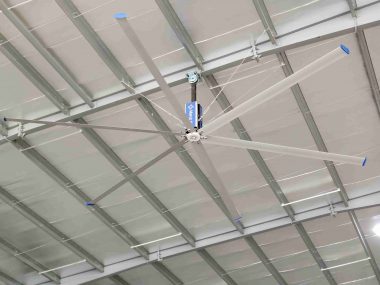
The green building codes require industrial buildings to provide fresh, comfortable air while minimising energy use. High-volume, low-speed (HVLS) fans will be necessary to achieve this objective due to their ability to move large volumes of air across large floor spaces.
What are the Requirements for Industrial Buildings in Green Building Codes?
These are codes that provide guidance to buildings regarding the use of energy, water, and materials. The Indian Energy Conservation Building Code (ECBC) and rating systems like IGBC, GRIHA, and LEED in India have been used in creating most green buildings. Instead of focusing on how to remove air for ventilation, the codes are more concerned about how much fresh air is brought in by the building, how comfortable the temperature is for the workers, and how all these can be achieved without using unnecessary energy. It is not mandatory to comply with all guidelines in every project, but there is an increasing demand from clients and export partners.
Why Traditional Ventilation Solutions Aren’t Enough
A number of the older plants are based on the design of having rows of exhaust fans and pedestal fans, but this doesn’t work because there are patches in which there is plenty of airflow but other spots that stay warm and muggy. Having all these fans operating raises the energy bill, and the use of air conditioning for a large building is often impractical. As green codes require that facilities find another way around this problem, it becomes necessary to change the strategy to improve airflow in the entire room. And here lies the gap that can be filled by ventilation technology such as HVLS fans.
Introduction to HVLS Fans and Their Mechanism
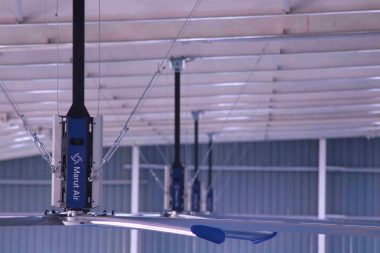
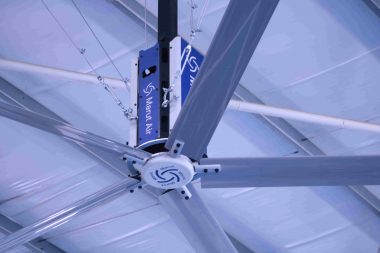
HVLS fans are ceiling fans that are usually large-sized (with diameters ranging from 8 to 24 feet) and work at a slow speed because their larger size allows them to push a great volume of air downwards in one turn. The air moves over the ground and rises up from the walls and circulates back again to create a smooth circulation of air throughout the room. The smaller size of the fans creates airflow quickly but not over a very large area.
HVLS Fans in the Service of Green Building Objectives
Reduction in energy consumption: since an area where several fans would be needed will be covered with one HVLS fan. In this way, less energy will be spent in the same area, and it is possible to save on AC energy. It contributes to energy efficiency and energy savings, ECBS, and green building standards.
Improved air quality: better air helps employees to work efficiently, because a steady flow of air does not let heat, moisture, and gases accumulate in one place.
Comfort of workers: quick movement of air increases the sweating process, so people can feel more comfortable without any temperature drop in large areas.
Natural ventilation support: thanks to open walls and a vented roof, fresh air comes inside, but it depends on the weather. The process of even air distribution is done by HVLS fans.
Where Do HVLS Fand Work Best?
HVLS work best in large, open spaces that have high ceilings, where air tends to sit and build heat. This is where they actually operate the best and give the strongest results:
Manufacturing Plants & Factories: There’s a release of a huge amount of heat from machines, furnaces, and welding zones. The high-volume, low-speed fans will circulate the air around the shop floor to decrease heat and make workers feel comfortable during their work.
Warehouses and Logistics Centres: Tall rooms filled with racks in warehouses and logistics centres usually have stagnant air that creates problems with humidity and makes it unevenly distributed in the room. Even distribution of the air will be created by the presence of the HVLS fans.
Cold Storage and Cold Chain Facilities: Here, the HVLS fans are utilised for mixing the air to create an even distribution of the cool air and decrease temperature differences between the floor and the ceiling.
Workshops and Fabrication Units: Fumes, dust, and heat are gathered very quickly in these workshops, and constant circulation of the air will disperse all these components and create a comfortable working environment.
Gyms, Showrooms and Large Commercial Halls: Large open spaces demand the even distribution of air, but noisy fans will ruin it because HVLS fans are quieter than usual fans.
Conclusion: Make Your Code Green with Marutair
Green building codes are not mere fads; they have redesigned the whole process of designing any new industrial space in India and ensuring that they have ventilation systems that would help them save energy and provide their employees with better places to work. HVLS fans are a convenient solution in making the switch happen.
Marut Air assists you in choosing the appropriate HVLS fans according to your needs, which depend on the size of the building and its requirements. Marutair takes care of all your ventilation needs from start to finish and ensures that you make the change.
Want to reduce your energy costs, ensure that your facility stays cool, and make your place green as well? You can count on Marutair for this as well. You can contact the Marutair team today for expert consultation and guidance for your space.
FAQs
1. What are HVLS fans?
HVLS stands for high-volume, low-speed ceiling fans that rotate slowly but circulate a high volume of air, making them suitable for use in factories and warehouses, among others.
2. Is the installation of HVLS fans mandatory under Indian green building codes?
Not necessarily, because the green building code does not mention any particular product. The objective is set, and HVLS fans are among many other products that meet the objectives.
3. How do HVLS fans conserve energy?
One HVLS fan covers a lot of area with low energy usage as compared to using many smaller fans, thus lowering electricity costs.
4. Can HVLS fans be used as an alternative to air conditioning in industrial buildings?
In big open spaces, they lower the usage of air conditioners since they cool down the space.
5. How many HVLS fans should I use in my building?
It depends on the floor area, ceiling height, and machinery.