
In addition to brand and style, performance is equally important. One of the most important variables that influence your ceiling fan’s ability to cool your room is ceiling height. The height of your ceiling (low, standard or high) affects airflow, efficiency and overall comfort.
This guide describes how ceiling height affects fan performance and explains how you can select the right ceiling fan for your room. Thus, you will have expert advice and practical information when making your decision about high performance ceiling fans from Marut Air.
The ceiling fan circulates air downward in a conical manner. If the fan is installed too high, by the time the airflow gets to the people using that space, there will not be as strong an airflow. On the other hand if the fan is installed too low, it will be blowing too much air toward you and/or make you feel unsafe.
Why Ceiling Fan At the Correct Height Matters?
A ceiling fan at the correct height will provide appropriate air circulation within the room, improve cooling effectiveness, circulate air evenly throughout the room, reduce energy consumption, and have the better overall performance. A ceiling fan that is set too high or too low will not perform well.
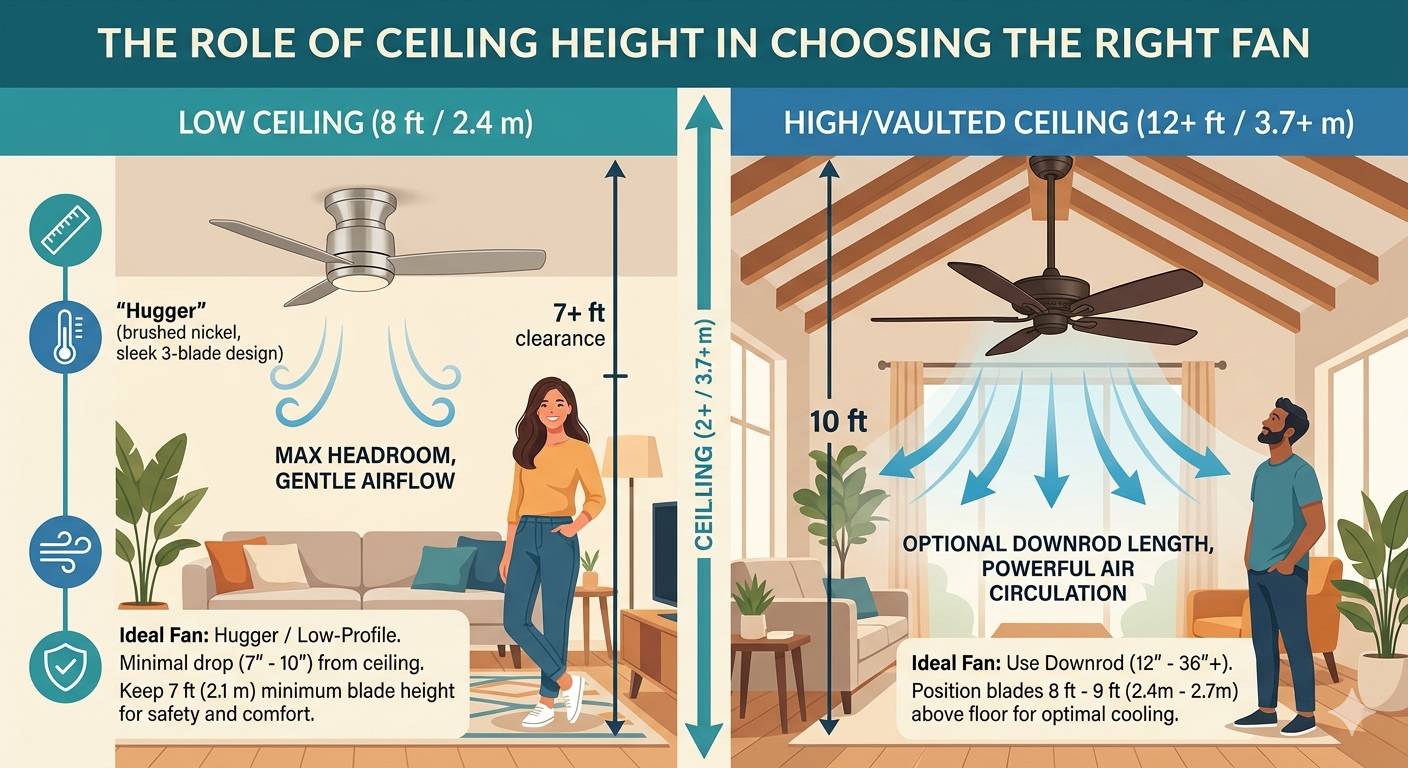
Here are the recommended ceiling height guidelines to ensure that fans function properly while being safely installed:
- The ceiling fan should be at least 7′ from the floor.
- The ideal ceiling fan height is 8-9′ from the floor.
- Minimum distance from the ceiling to the top of the fan blades will be a minimum of 10-12″.
This range of distances from the fan to the ceiling guarantees that the fan will be able to produce maximum airflow while ensuring the safety and comfort of those in the room.
Ceiling Fan Installation Height and Its Effect on Fan Performance
Airflow distribution will vary based on the height of the fan above the floor. If a fan is too close to the ceiling it will restrict the fan from drawing air into its blades; if the fan is placed too high the fan will distribute air before it reaches the floor, resulting in uneven airflow throughout the room. If the fan is installed properly, it will produce a consistent airflow throughout the room.
Cooling Effectiveness: Fans do not lower ambient temperature; fans create a wind-chill effect. If the height of the ceiling fan is incorrect, the wind-chill effect is reduced and the area around the fan will feel warmer than it should.
Energy consumption: Improper fan installation generally causes fans to operate at a higher-than-necessary speed and use more energy than is necessary to effectively circulate air in that space.
Comfort levels: When a ceiling fan is properly positioned, the fan will provide a balanced cooling effect throughout the entire room versus providing concentrated cooling to a specific location.
Selecting the Appropriate Fan According to Your Ceiling Height
Low Ceilings (Under 8 feet)
If you need to install a fan in a low-ceilinged area (under 8 feet), consider using a flush-mounted (hugger) fan with blades that are 36-44 inches…and do not use any downrods longer than about 5 inches. The blade should be positioned immediately beneath the ceiling, which will provide sufficient airflow.
Standard Ceilings (8-10 feet)
Most Indian homes have 8-10 feet high ceilings; therefore, you would use standard ceiling fans with shorter downrods. The fan blades should be 48-52 inches in diameter and work well in spaces like bedrooms, living rooms, and offices. All of the ceiling fans manufactured by Marut Air were designed for optimum performance in this category; they combine excellent energy efficiency with contemporary style.
Ceilings Greater Than 10 Feet
When installing your fan in a tall-ceilinged room, there are some special considerations. You need to purchase a fan with long downrods…and you should select a fan with larger than normal blades (52-60 inches or larger). Make sure that all of these fans are installed to hung 8-9 feet above the floor. When a fan is set up this way, it provides maximum airflow to the people using the room as opposed to allowing the airflow to dissipate and be lost to the air before it reaches the floor.
The Logic behind Selecting Your Downrod Length
The height of your downrod is extremely important when you are selecting your fan for your room. Use the following formula to calculate the length of your downrod.
Downrod Length = Ceiling Height – Desired Fan Height (8-9 feet)
For example, suppose you have a ceiling that is 12 feet high. You want your fan to be approximately 9 feet from the floor. So your downrod will be 3 feet long. By using the above equation to calculate downrod lengths, you will achieve optimum airflow and also be safe.
Ceiling Height vs Fan Size (Critical Selection Guide)
Selecting the right fan size along with ceiling height is key to achieving maximum efficiency.
| Ceiling Height | Room Size | Fan Sweep Size | Downrod Length |
| 7–8 ft | Small rooms | 36–44 inches | Flush mount |
| 8–10 ft | Medium rooms | 48–52 inches | 3–6 inches |
| 10–12 ft | Large rooms | 52–56 inches | 12–24 inches |
| 12+ ft | Large/open areas | 56–60+ inches | 24+ inches |
Ceiling height and fan size together determine how well a fan will perform and create comfortable air movement. You can dramatically increase fan performance and make a comfortable environment by properly selecting your ceiling height and improving the size of your ceiling fan.
Common Mistakes to Avoid when Choosing The Fan:
Many homeowners have unknowingly limited the performance of their ceiling fan due to mistakes, including:
- Placing their ceiling fan too close to their ceiling
- Failing to account for the depth of false ceilings
- Choosing the wrong size fan
- Not maintaining proper clearance from the wall
- Using a short downrod with a tall ceiling;
If you can avoid these mistakes, you will increase the amount of airflow from your ceiling fan without spending more money on the purchase of the ceiling fan itself.
How to measure your ceiling height accurately before buying a ceiling fan
You must measure your ceiling height before you buy your ceiling fan to make sure you purchase the right size fan and downrod.
- Measure the distance from your floor to the actual ceiling slab.
- In the case of false ceilings, measure the distance from the finished surface of the ceiling to the floor.
- Be aware of any lighting fixtures or beams that may impede a proper mounted location.
- By taking accurate measurements, you will ensure you select the proper ceiling fan type and downrod length.
Expert Tips for Maximum Cooling Efficiency
According to the manufacturer’s instructions, the following will help maximize effectiveness and efficiency of a ceiling fan:
- Installing the fan at the center of the room.
- Using the correct pitch on the blades will improve air movement.
- Adjusting the speed settings according to the size of the room.
- Using reverse mode during the winter season to circulate air.
- Keeping the blades clean, as it will help maintain efficiency.
Making just a few of these changes can greatly increase your comfort level, while decreasing your monthly electric bill.
The Best Ceiling Fans for Different Ceiling Heights
When purchasing a ceiling fan, ensure that it fits both the height of your ceiling and requirements for your specific needs.
Marut Air manufactures several models of ceiling fans for:
- Low-ceiling compact spaces
- Standard residential-sized rooms
- Commercial and/or high-ceiling luxury spaces
With their emphasis on airflow efficiency, durability, and contemporary design; you are assured of optimal performance from their ceiling fans regardless of the height of your ceiling.
Final Thoughts
Ceiling height has an important role in determining how effectively a fan operates. Factors such as the distribution of airflow throughout the room, and the overall energy efficiency of the system, are greatly influenced by the distance between the top of the ceiling and bottom edge of the fan.
Understanding how ceiling height and size of the fan, along with downrod length, related to each other will enable you to make a more informed decision regarding the comfort level, and reduction in energy consumption, whether upgrading your previously purchased fan or having new fans installed.
Frequently Asked Questions for The Role of Ceiling Height when Choosing The Right Fan:
Am I able to install a ceiling fan in a room with a low ceiling height?
Yes, it is possible to install ceiling fans to low ceiling heights through using flush mount (hugger) ceiling fans; these fan types maintain the necessary airflow while keeping the fan close to the ceiling to provide the required safety and comfort levels.
Does the height of the ceiling impact the ability of ceiling fans to cool the air?
The height of a ceiling will affect air movement as well as how well any fan will cool off an area itself. If a ceiling-mounted fan is installed too high or too low, the amount of air moved will be impaired by this wrong height due to insufficient air movement causing the area to be uncomfortable, resulting in increased electrical costs due to a higher setting or more use.
What size of fan should be used for a high ceiling?
A larger fan is ideal for a high ceiling because of longer downrods; for example, to obtain the proper amount of airflow throughout the entire space, use fans with an average sweep size of 52 inches or more.
How do I determine how long my down rod should be?
In order to calculate the ideal length for my down rod, I must take the ceiling height and subtract the ideal height of the installed fan (the installed fan should be at least 8–9 feet off of the ground) to determine how far down from the ceiling to install the fan, which is the best length for proper airflow and comfort.
Is it always better to use a larger ceiling fan when installing one in an area with a high ceiling?
Not necessarily; while larger ceiling fan will be the most appropriate for high ceilings, a longer downrod that is properly measured and selected for each is required for a large ceiling fan to provide adequate air movement.