
Felt the heat of the terminal on your face the moment you step off your plane after a long and tiring flight while hauling your luggage through an equally sweltering airport? You are definitely not the only one. Airports are one of the busiest, most frequently visited indoor spaces in the world, and maintaining a comfortable temperature at these locations with thousands of passengers coming in and out every hour is definitely not that easy.
In order to overcome all of this, a large number of airports in India and worldwide are adopting the use of HVLS (High Volume Low Speed) fans.
These larger and slower rotating ceiling fans are softly revolutionizing and uplifting the airport terminals by circulating immense quantities of air at a low cost, without creating any heat or occupying too much space like conventional methods of cooling. Hence, the increasingly rapid acceptance of HVLS fans for airport operators is an assurance that the airports of the present and future are actually considering passengers’ comfort from scratch.
The Growing Challenge of Cooling Large Airport Terminals
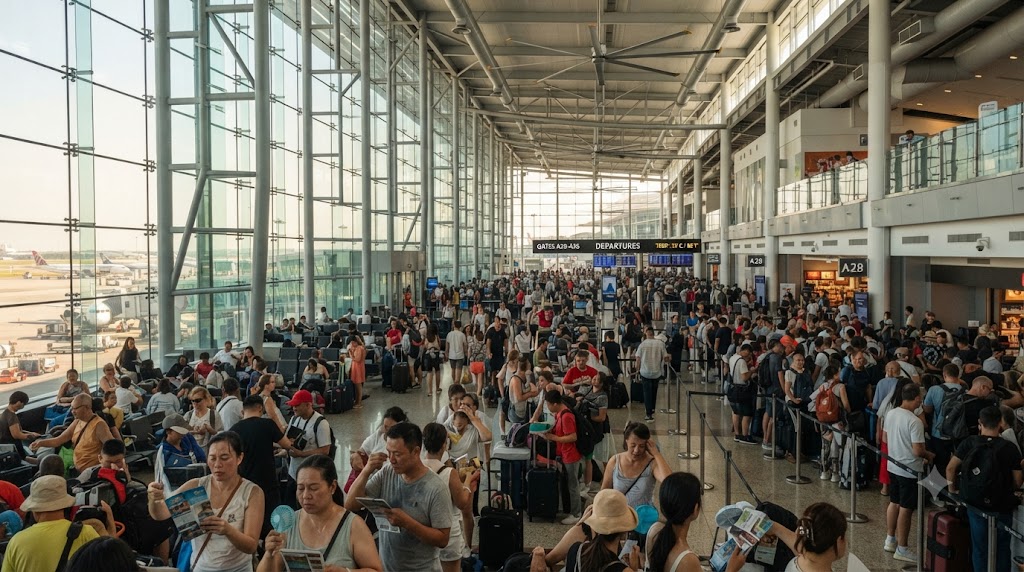
The architecture of the airport terminals is distinctly specific, consisting of towering high ceilings, expansive open spaces with glass enclosures which retain heat, and never-ending traffic of travellers departing and arriving from all over the globe. While conventional air conditioning systems have proven efficient within smaller rooms, it is an insufficient answer for heating or cooling wide volumes; the cold air often fails to cool the air volume. Hot air would consequently be trapped on the high ceiling, whereas passengers are standing and walking at the ground level and will remain uncomfortably heated. Air distribution becomes inefficient resulting in temperature inequalities and stale air.
What Makes HVLS Fans for Airports Different From Conventional Cooling Solutions
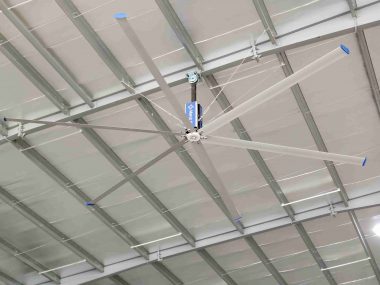
HVLS fans utilize a high volume, low-speed approach. Their large diameter fans (8′-24′ in diameter) revolve at a very slow rate (between 30-50 RPM). Unlike regular ceiling or portable floor fans which provide concentrated, short blasts of air in one direct path, an HVLS fan will provide a concentrated but wide column of air flow which reaches all the way down to the floor.
Once the air column reaches the floor, the air mass then fans out to create what is known as the destratification effect where warm air pooling at the ceiling is introduced with the cooler air at the floor, levelling the temperatures within the terminal.
What you experience from an HVLS fan is a constant gentle breeze making large open environments seem considerably cooler without making you feel chilled.
How HVLS Fans Improve Passenger Comfort and Experience
In addition, airports around the world regard passenger experience as an ever more central aspect of their operations, and thermal comfort plays an even greater role in that than we realize. Standing in long queues for check-in, security, or boarding means that passengers, whether they like it or not, spend large amounts of time stationary. HVLS fans alleviate these long waits by ensuring a constant distribution of airflow throughout the main passenger waiting and throughput areas and minimizing the rather stuffy/recycled feeling of sealed-in airport buildings by keeping the air consistently circulating in a mild and barely noticeable way. This is the small difference which passengers struggling with jet lag or prolonged layovers truly appreciate in a stressful travel environment.
Energy Efficiency and Cost Savings for Airport Operators
In addition to the passenger convenience of HVLS fans, they also present a strong economic argument to airports. Since HVLS fans actually move air instead of cooling the air, they are far more energy efficient than running a fully capable AC system 24 hours a day. The HVLS fans allow you to set the AC control up by a degree or two and not know it, due to the “wind chill” factor moving the air, and this is where the real money saves itself-at the end of the month your electricity bill is less due to lowering what it is setting the AC to and the cooling systems aren’t working as hard, and when an entire terminal draws enough power to power a town, even degrees make a difference.
Supporting Sustainability Goals in Modern Airport Design

Environmental concerns mean airports everywhere need to go greener. As a building certification, airports will look to get a green building certification. HVLS fans, using considerably less energy than air conditioning yet still providing acceptable results can be used quite successfully to cut down energy consumption in these applications. A lot of airport terminals being designed today are planning around the use of HVLS fans rather than incorporating them later on in the build and they can also be a part of the initial thought process in many building plans.
Conclusion
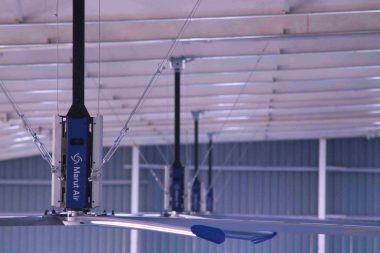
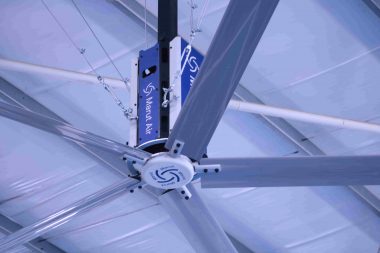
With so much constant growth for the aviation industry on all levels and year over year increases in passenger numbers, the need for “smarter” and more “sustainable” cooling solutions in airports is sure to rise. HVLS fans are already proving to be an efficient energy-saving solution to the demanding needs required when cooling expansive terminals, keeping passengers comfortable while using less energy compared to traditional systems on their own. A company like Marut Air has been a leader in the design and manufacture of large HVLS fans to effectively handle vast commercial and industrial spaces, such as those required in the aviation industry. When looking to find a quality cooling solution for a large space, understanding HVLS technology is important to consider.
FAQs
Q: What exactly are HVLS fans, and why are airports suddenly using them?
Basically, HVLS is the acronym for High Volume Low Speed, which literally is the definition. It’s those big ass fans which sometimes you will find hanging from really high ceilings and spinning slowly at a very slow pace but will move around a lot of air. Airports seem to have embraced it as the sheer size of the airport terminal means air can stagnate with conventional air-conditioning alone.
Q: Will I actually feel the difference as a passenger?
Oh, definitely more than most people realize! If you’ve ever been at the security line, stuck. Like the air around you just doesn’t seem to move, that is what HVLS fans are good for-to keep that air circulating just enough so that even when there’s a hundred people in a tight space it doesn’t feel stuffy.
Q: Are these fans noisy? I don’t want more airport noise.
Yes the news is that they are designed to be quiet. As they turn slowly they do not produce any noise like a faster smaller fan. Most passengers would not even know they exist except for the cooling air.
Q: Do HVLS fans replace air conditioning completely?
They actually accompany it, not replace it. It can be seen as something of an accessory to the system itself; it merely mixes and distributes the cold air from the AC, creating a flow down to the level where everyone is standing (instead of all of it being at the top of the room).