
India’s Manufacturing Boom: Why Ventilation Planning Belongs in Your Factory Setup Checklist – The manufacturing industry in India is set to witness its golden era of growth. Manufacturing GVA increased by 7.72% in Q1 and 9.13% in Q2 in FY 2025-26, while manufacturing output has grown by 8.1% in December 2025. As investments in the automotive, electronics, pharmaceuticals, food processing, engineering, and other industries are growing, the factory design is aimed at enhancing production and increasing efficiency.
There is one factory design aspect that should not be overlooked: industrial ventilation.
When designing your factory or planning an extension of your existing plant, include ventilation on your factory design checklist alongside machinery placement, electrical equipment, fire safety, floors, lighting, and utilities. A properly designed industrial ventilation system may help in managing heat, improving indoor air quality, enhancing comfort, and productivity in the factory.
Why Do You Need Industrial Ventilation?
Manufacturing processes may generate heat, dust, fumes, humidity, smells, and other contaminants. Without appropriate air circulation and exhaust, these factors may build up in the industrial facility.
An efficient industrial ventilation system ensures that polluted air is circulated while ensuring that there is air movement to circulate fresh air. In addition, it plays a vital role in controlling any excess heat and humidity.
In India, this is of much importance considering that high summer temperatures may cause an additional heat load in factories.
Ventilation System Planning Before Factory Building
One of the major blunders by many manufacturers is to incorporate ventilation systems after the factory operations have been put into place.
Ventilation systems should be planned during the process of factory design and layout. The location of production lines, machines, heat-generating machines, doors, windows, storeroom, and worker area affects the airflow requirement of a factory.
Proper planning ensures that the manufacturer answers questions like:
- Where will the heat and fumes be generated?
- Where does the exhaust ventilation need to be applied?
- Where will fresh air enter the factory?
- How will the air circulate in the factory production floor?
- Which areas need to be cooled down specifically?
- What kind of ventilation capacity will the factory require with increasing production?
Some Major Elements of an Industrial Ventilation System
There might be situations where more than one solution needs to be adopted in a modern factory.
1. HVLS Fans for Large Manufacturing Areas
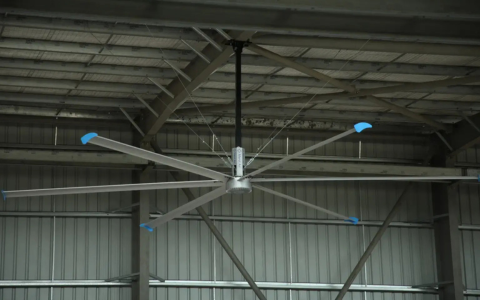
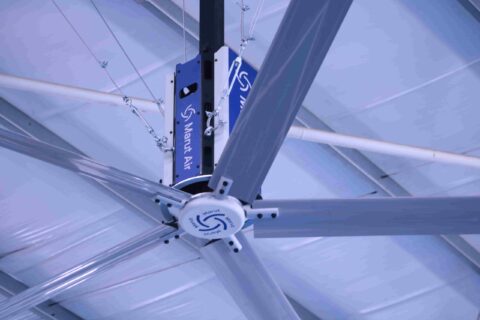
HVLS fans are used to move large amounts of air in big spaces. They are used to facilitate airflow and maintain thermal comfort in warehouses, workshops, and manufacturing sites.
2. Industrial Exhaust Fans
Industrial exhaust fans are especially effective when heat, fumes, dust, or stagnant air needs to be removed from certain parts of a factory. The proper positioning of exhaust fans is critical for their effectiveness.
3. Industrial Air Coolers
Where applicable, industrial air coolers can offer an eco-friendly way to cool large open spaces. The factory cooling solutions by Marut Air use evaporative cooling combined with air movement in industrial applications.
4. Airflow Management
Different parts of a factory have different ventilation needs. The production areas, the loading areas, storage areas, and the workstations all require a separate ventilation strategy. Therefore, it makes more sense to design for better ventilation in a building than to install as many fans as possible in a building.
How Better Ventilation Increases Efficiency of Factories
The comfort of the workplace can improve the efficiency of employees and the level of safety of work processes. Heat, bad ventilation, and pollution can complicate the working process of hard manufacturing plants.
At the same time, ventilation can assist in protecting equipment. Regulation of excess heat, humidity, and dust can be helpful for creating more favourable conditions for machinery and the manufacturing process.
Therefore, manufacturers who care about energy saving, workers’ safety and productivity, as well as low cost of long-term operations, should regard ventilation as an integral element of their factory infrastructure rather than as a separate cooling technology.
Factory Setup Checklist: Ventilation Role
When starting up a manufacturing plant, you should take into account the following checks concerning ventilation issues in your factory setup checklist:
Evaluate heat-producing processes
Identify machines and production processes that raise indoor temperature.
Evaluate airflow needs
Analyze your factory design and find out places where air circulation and exhaust are needed.
Estimate exhaust spots
Place exhaust systems in the right places according to the sources of heat, fumes, or other pollutants.
Consider height and square footage of building
Large facilities with tall roofs need special planning of air circulation.
Estimate energy usage
Choose ventilation and cooling methods based on the operation requirements of the factory.
Plan for future expansions
The ventilation system must be able to adapt to the changes in production capacity whenever possible.
Seek professional advice
Expert guidance can be beneficial in planning the entire process in terms of equipment selection, ventilation requirements, and factory layout.
Conclusion
As India witnesses a surge in its manufacturing industry, there will be a need for modernized, energy-efficient, and comfortable manufacturing plants. As you prepare the list of things you will require for the factory setup, don’t overlook the planning of industrial ventilation in the last stages.
Marut Air offers industrial ventilation solutions, which include HVLS fans, exhaust fans, industrial air coolers, and mobile fans. If you are setting up a new factory or upgrading an existing one, connect with Marut Air and explore the industrial ventilation options for your facility.
FAQs
What is the significance of ventilation in manufacturing plants?
Indoor ventilation systems regulate heat, dust, odours, humidity, and poor ventilation in a factory, which can create a safer working environment.
Which is the most efficient ventilation system for an extensive factory?
There is no one-size-fits-all solution. Different types of solutions may work, depending on the nature of the building and its manufacturing process: HVLS fans, industrial exhaust fans, industrial air coolers, and specific ventilation, among others.
Is it viable to install HVLS fans in Indian factories?
Yes. HVLS fans may be used in large-scale manufacturing plants, warehouse buildings, and any other place requiring extensive air circulation. The correct size and number of fans should be chosen based on facility characteristics and applications.
Is it possible that factory ventilation can save on energy expenses?
Effective ventilation and cooling systems may assist in increasing air movement and improving thermal comfort without excessive use of traditional air conditioning. Nevertheless, savings on energy consumption will depend on the particular characteristics of the building.
When is ventilation planning recommended to start in a new factory?
Ideally, ventilation planning should be started at the design and layout stage of a new factory before the construction of a new building. Planning enables airflow, exhaust positions, and cooling needs to be combined into the overall building design.