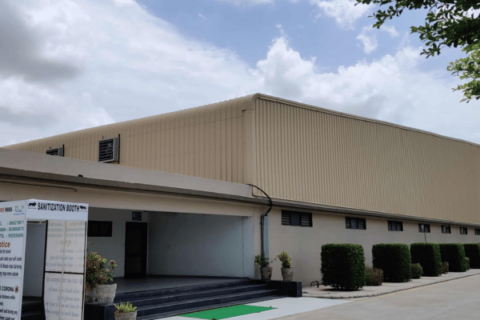

Large commercial spaces tend to experience heat buildup, stagnant air, temperature extremes and poor air circulation. Conventional fans may be able to circulate air to a small area, but they are unable to deliver consistent airflow throughout several thousand square feet of space. That’s where HVLS fans come in. In this blog, Marut Air will provide you with everything you need to know about what an HVLS Fan is and how it works to provide constant air flow throughout the workspace.
What Does HVLS Stand For?
HVLS stands for:
- High Volume – Moves a large amount of air
- Low Speed – Operates at low RPM
Thus, when looking to improve circulating airflow in warehouses and manufacturing plants using HVLS fans, you can count on these advantages:
- Wider airflow footprint
- Lower operating costs
- Less noise
- More comfortable working conditions for employees throughout the entire facility
The combination of high volume and low speed is the most important feature of HVLS fans. Rather than spinning quickly, as most smaller industrial-type fans do, large HVLS fans will spin slowly but will push a considerably larger volume of air down and out from the fan than a smaller fan would with the same rotational speed.
What Is an HVLS Fan?
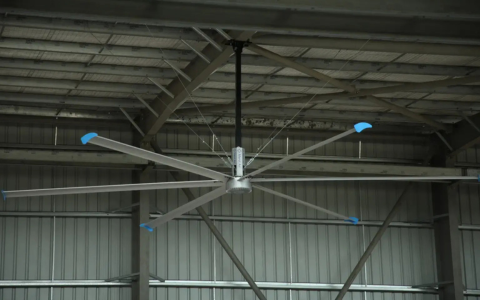
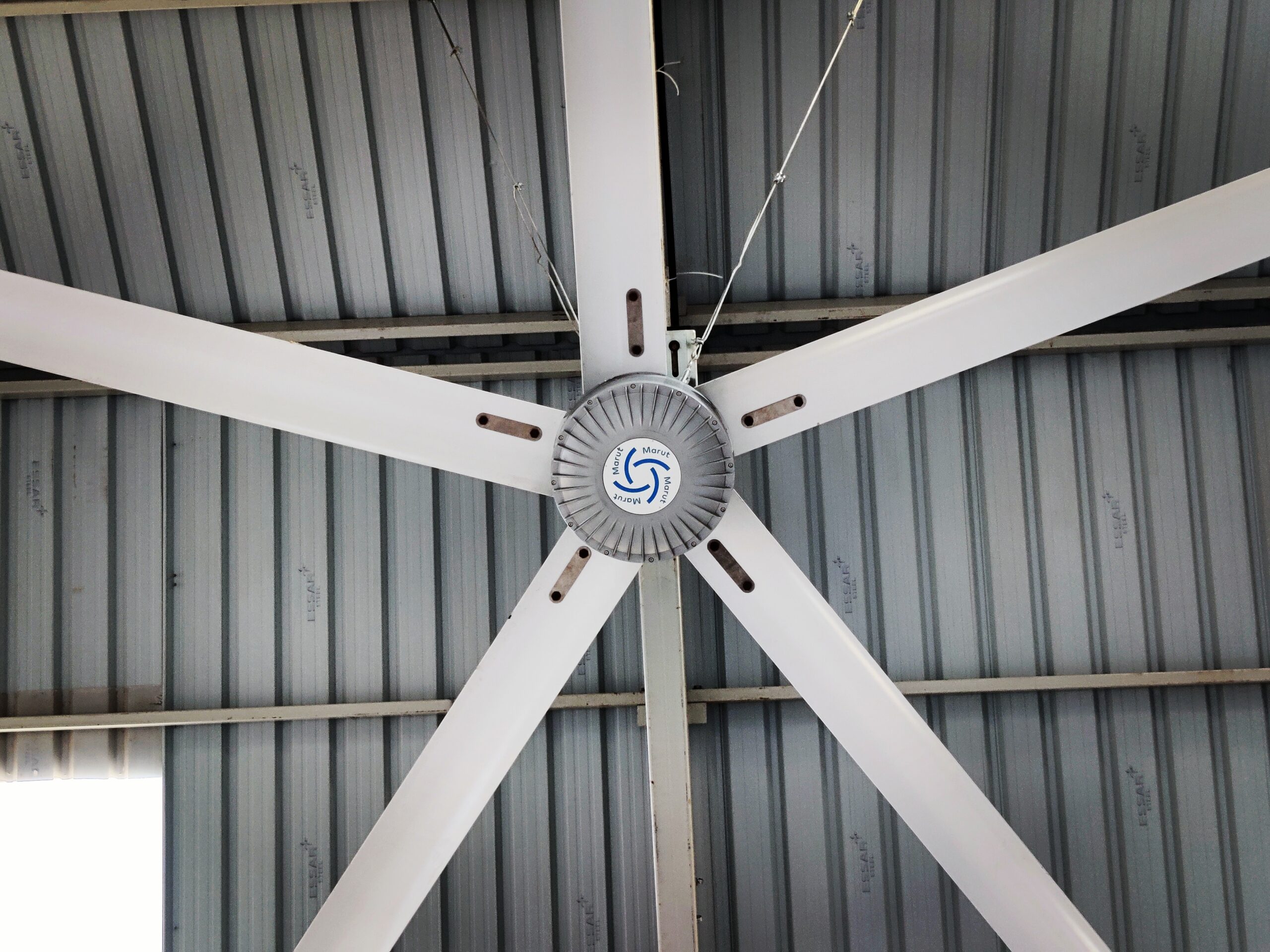
HVLS fans are large, typically ceiling-mounted (or wall-mounted) industrial-type fans with powder coated steel or aluminium blades between 72 and 240+ inches in diameter. They are generally used in large-scale industrial/commercial-type ambient air circulation environments.
HVLS fans generate a gentle, consistent, and powerful airflow (a column of air) over a very large area of the floor, creating an even distribution of air from the ceiling to the ground and moving horizontally within the entire floor area.
How Does an HVLS Fan Work?
HVLS fans’ effectiveness relies on their engineering and airflow dynamics.
Large Aerodynamic Blades
HVLS fans utilise airfoil blades that are specifically engineered, similar to an aircraft wing to achieve maximum air flow efficiency while minimising both drag and energy loss.
The large diameter of the fan allows the fan to:
- Move huge volumes of air with each revolution
- Have the ability to cover a much larger floor area
- Operate in a much more efficient manner, even at a low speed
Low Speed of Operation
Unlike traditional industrial fans that operate at high RPM’s, HVLS fans operate at significantly slower speeds than their traditional industrial counterparts which reduces energy consumption while still providing an adequate amount of airflow output.
Benefits include:
- Lower rate of electrical consumption
- Reduced mechanical wear on fan components
- Quieter operation
Vertical Column of Air Effect
As the HVLS fan rotates it displaces a column of air in a downward direction towards the floor surface. When this column of air reaches the ground surface it then provides horizontal flow (expanding the airflow in all directions) which results in continuous air circulation in the entire area served by that particular HVLS fan creating:
- Elimination of stagnant air (Dead) spaces
- Improved ventilation
- More even distribution of ambient temperature throughout the entire area served by that particular HVLS fan.
Destratifying Effect
In significant structures, heat rises, accumulating at the ceiling and creating stratification. However, HVLS fans provide a way to combat this problem.
During the cold seasons, a period when a substantial amount of air is trapped because of the warm air/ceiling relationship HVLS fans:
- Push warm air that is trapped down to the floor
- Balance out the temperature throughout the room
- Lower your heating bill
- This is also referred to as destratification
Cooling Effect
Unlike AC units, HVLS fans do not drop air temperature, but will create a wind-chill effect by increasing the airflow across your body, which will:
- Improve evaporative cooling.
- Make you feel colder than you do without a fan.
- Increase your comfort level.
- An increase in air movement of as little as 2–3 mph will cause a space to feel 4–6°F cooler.
What are the Key Components of an HVLS Fan
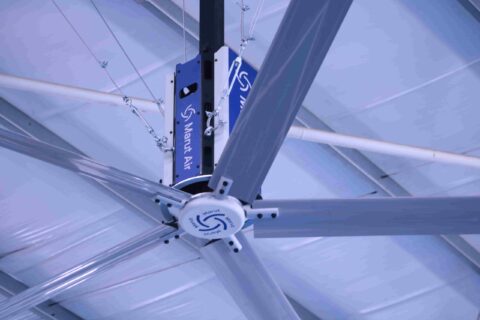
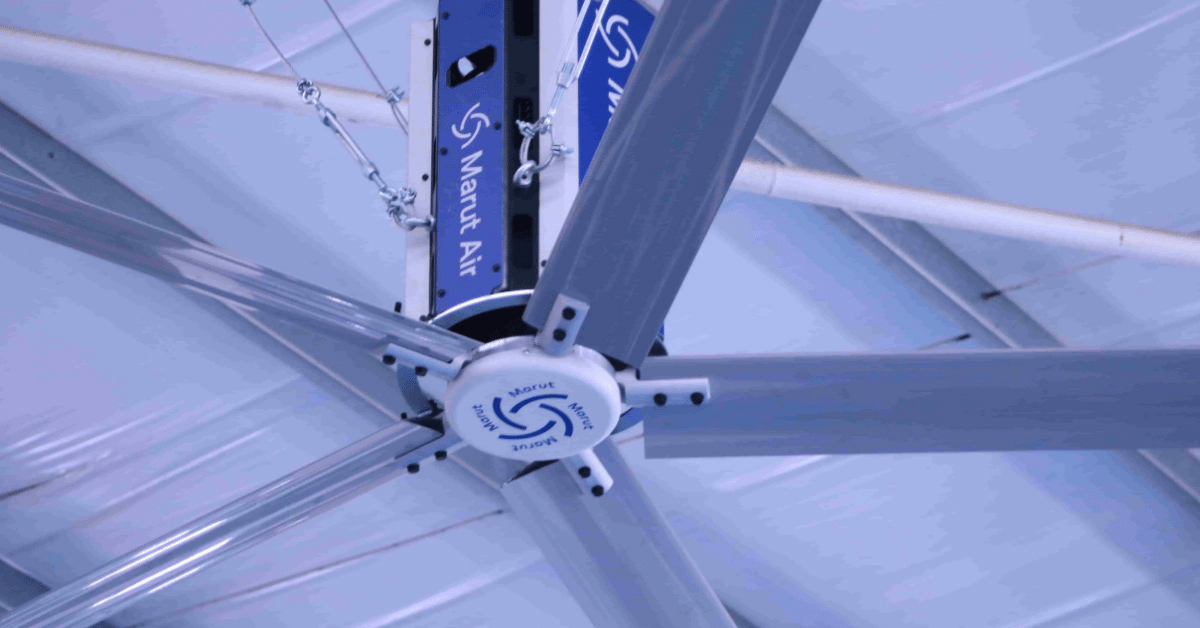
- Hub Assembly: Connects blades to motor
- Airfoil Blades: The large blades of an HVLS fan are designed to be aerodynamic.
- Motor (Gear driven or Direct drive)
- Mounting System: Provides a means of attaching the fan to the building structure.
- Controller/VFD: Allows for speed adjustment.
- Safety cables: Provide an additional layer of protection
What are the Key Benefits of HVLS Fans?
Here are some of the key benefits of HVLS fans, which include the following:
Airflow & Comfort: The large amount of air moving from your HVLS Fan creates a consistent airflow lowering the amount of stagnant air along with creating hot and cold spots. Thus providing comfort to the worker in your building.
Year-Round Benefits: Your HVLS Fan is not just made for summertime. In the summertime, it keeps your building cool and in the wintertime when it is run in reverse, it will push the warm air that is at the ceiling level back down to the floor level.
Humidity & Moisture Control: By preventing condensation and reducing mould growth, you protect not only your products but also your inventory.
Quiet: A HVLS Fan will move large volumes of air while producing very little noise, making them an ideal choice for industrial (warehouse) and commercial (retail) work environments.
Enhanced Productivity: By providing a more temperate working environment, using an HVLS Fan creates a more comfortable environment for employees, therefore reducing their fatigue and stress levels caused by excess heat during working hours.
Where Are HVLS Fans Used?
HVLS Fans have many uses, some of which include:
- Industrial HVLS Fans: Warehouse, factory, distribution centre, and manufacturing facilities.
- Commercial HVLS Fans: Health Clubs or Gyms, Retail Stores, Places of Worship such as churches, Arenas, Airports, and commercial buildings.
- Agricultural HVLS Fans: Buildings for Livestock and Dairy, as well as Growing Structures such as Greenhouses.
What are the Key Differences Between HVLS Fans vs Traditional Industrial Fans?
| Feature | HVLS Fans | Traditional Industrial Fans |
| Blade Size | 7–24 ft large diameter | 2–4 ft smaller size |
| Speed | Low RPM | High RPM |
| Airflow | Wide, uniform coverage | Narrow, direct airflow |
| Coverage Area | Large spaces (10,000+ sq. ft.) | Small, localised areas |
| Energy Use | Highly energy-efficient | Less efficient (multiple units needed) |
| Noise | Quiet | Louder |
| Best For | Warehouses, factories, gyms | Spot cooling, small rooms |
FAQs About HVLS Fan & Its Working Process
Question 1. How do HVLS fans cool a space?
HVLS fans can create a wind chill factor that cools the skin of individuals in a space by increasing the amount of air moving across their skin. This creates an evaporative cooling effect and decreases the air temperature perceived by those in the space.
Question 2. What is the ideal mount height for an HVLS fan?
Most HVLS fans require a mount height of 14′-16′ or higher to perform safely and effectively.
Question 3. Can HVLS fans be used in factories that have heavy machinery?
Yes, HVLS fans, in general, will assist in distributing heat generated from the machines within the factory. They also assist in providing better air circulation in areas that have higher temperatures.
Question 4. How much area will one HVLS fan cover?
The area that can be covered by one HVLS fan is based on the size of the fan and the height of the ceiling. In general, HVLS fans can cover 10,000 sq ft to 20,000+ sq ft of area with one fan.
Conclusion
To sum up everything that has been stated so far, the above given information on the topic “What Is an HVLS Fan and How Does It Work?” states everything you need to know about HVLS fans, their uses, applications and how to choose the right HVLS fan for your industrial or commercial space. If you are also looking for an HVLS fan for your workspace, feel free to contact us by dialing +91 63526 03898 or emailing ops6@marutair.com. Visit Marut Air’s Website today!