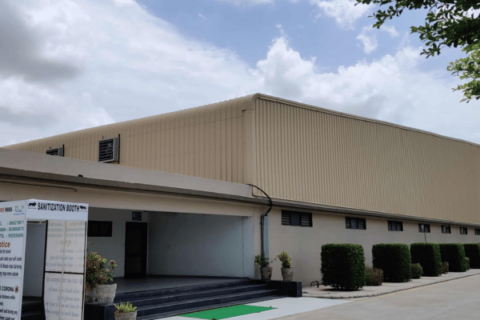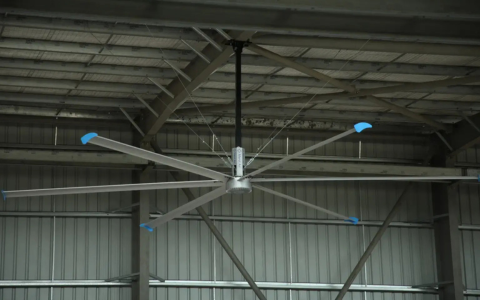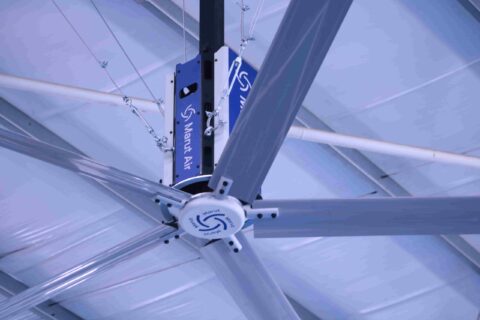

Ventilation systems are essential for large spaces to maintain fresh indoor air quality, control temperature, and create a productive working environment. Larger spaces like factories, industries, and warehouses are highly dependent on industrial exhaust fans to remove heat, dust, moisture, and contaminants from the indoor air. Nowadays, multiple types of exhaust fans are available in the market, which makes industries confused about choosing the right ventilation system between wall-mounted industrial exhaust fan and roof exhaust fan.
In this guide, you will learn the difference between wall-mounted industrial exhaust fan vs roof exhaust fan, their applications, and factors to consider before choosing an industrial exhaust fan.
What Are Wall Mounted Industrial Exhaust Fans?
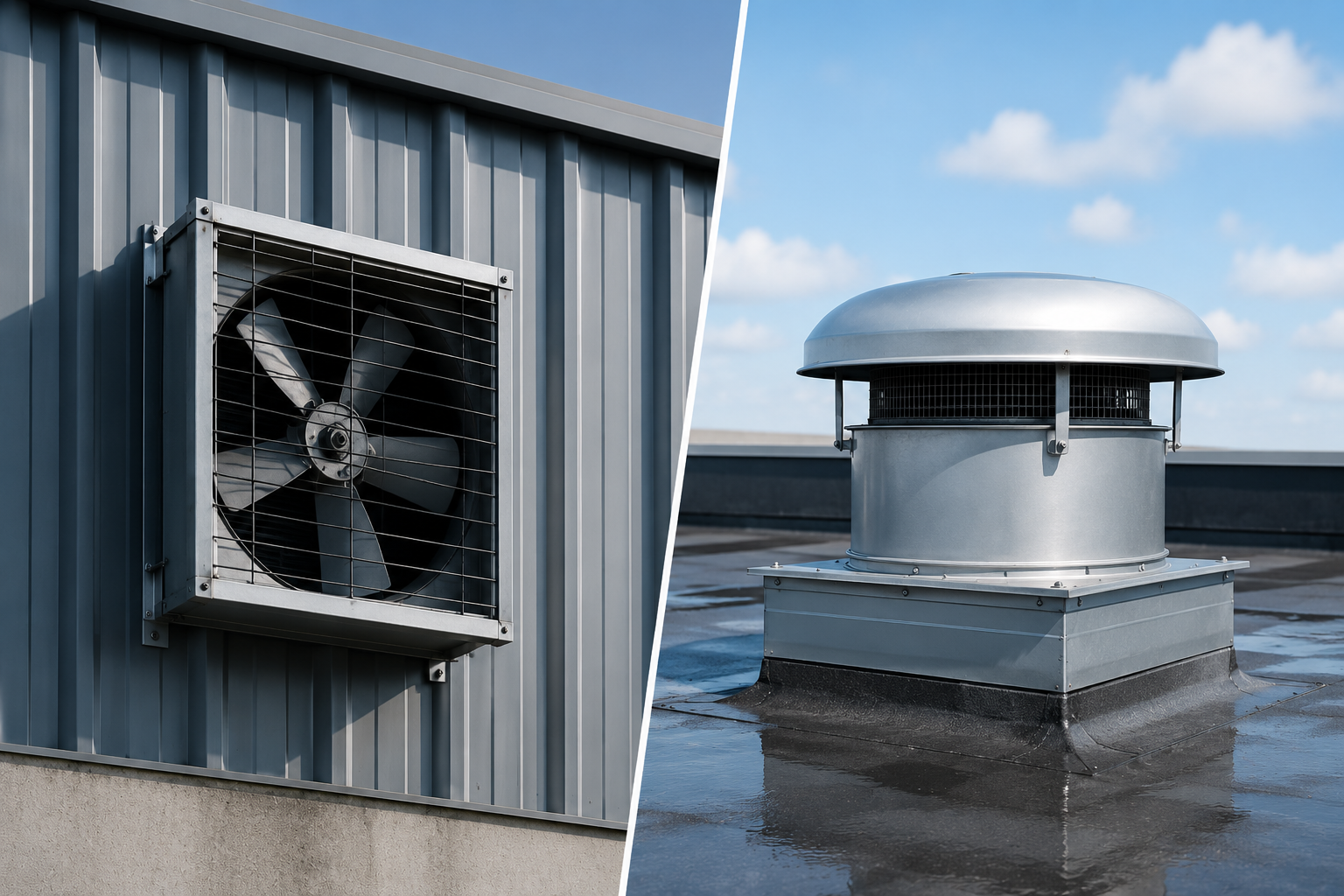
Wall-mounted industrial exhaust fans are industrial fans that are directly installed on the wall of large spaces to remove hot air, smoke, fumes, and moisture from indoor spaces to the outside. These fans pull the indoor hot air through their blades and push it outside through the wall opening to create better air circulation inside the space.
Advantages of wall-mounted exhaust fans:
- Easy to install
- Lower setup costs
- Simple to maintain and repair
- Best for compact spaces
- Improve ventilation efficiency
Applications of wall-mounted exhaust fans:
- Manufacturing rooms
- Printing and garment industries
- Workshops and warehouses
- Food processing facilities
- Machinery cooling areas
What Are Roof Exhaust Fans?
Roof exhaust fans are industrial fans that are installed on the rooftop of industrial buildings to extract hot air, smoke, airborne contaminants, and humidity vertically upward through roof openings. They use the natural tendency of hot air to rise upward. These fans are widely used in large spaces near the ceiling and roofs to remove trapped air and enhance the overall performance of ventilation systems.
Advantages of roof exhaust fans:
- Better performance of ventilation systems
- Effectively raises hot air upward
- Best for large facilities like manufacturing plants, warehouses, etc
- Reduces indoor temperature and improves working performance
- Improves air distribution inside the space
Applications of roof exhaust fans:
- Food manufacturing factories
- Commercial stores
- Large factories, workshops, and warehouses
- Pharmaceutical manufacturing factories
- Steel and textile industries
What Are the Differences Between Wall Mounted Industrial Exhaust Fan Vs Roof Exhaust Fan?
Both ventilation systems help industries to remove contaminated air from indoor spaces, but they have different installation positions, airflow direction, coverage capacity, and suitability.
| Factor | Wall-mounted exhaust fan | Roof exhaust fan |
| Installation position | Mounted on exterior wall | Installed on building rooftop |
| Airflow direction | Horizontal | Vertical |
| Ventilation coverage | Localized | Large area |
| Installation cost | Lower | Higher |
| Air removal efficiency | Moderate | High |
| Maintenance access | Easier | More complex |
| Suitable building size | Small to medium buildings | Medium to large buildings |
| Air extraction | Remove limited ceiling heat | Remove excellent ceiling heat |
What Are the Factors to Consider Before Choosing an Industrial Exhaust Fan?
These are some key factors to consider before you choose an industrial exhaust fan.
- Size of your building
- Height of rooftop
- Amount of heat generated
- Initial setup costs
- Access for maintenance
- Objective of using an industrial exhaust fan
Which Exhaust Fan is Best for Your Space?
Both exhaust fans are used for different purposes, so analyse your space before choosing any of them.
Select wall-mounted exhaust fans when:
- Your space is small or medium in size
- Required localized ventilation system
- You have a limited budget
- You need easy maintenance systems
Select roof exhaust fans when:
- Your space is large in size
- High heat accumulation inside the space
- Required large area ventilation coverage
- High rooftop height
Many industries use a combination of both systems to achieve balanced airflow inside the space and to enhance the performance of ventilation systems.
Conclusion
If you understand the difference between wall-mounted industrial exhaust fans and roof exhaust fans helps you choose the best one for your spaces. Both work better depending on the building structure and heat level. If you are looking for economical and localized ventilation solutions, choose wall-mounted industrial exhaust fans. But if you want efficient heat extraction and large-area air circulation systems, choose roof exhaust fans. Selecting the right ventilation helps industries to improve their indoor air quality and create safe and productive working environments. If you want to install industrial ventilation systems or exhaust fans in your spaces, contact Marut Air.
FAQs About Wall Mounted Industrial Exhaust Fan vs Roof Exhaust Fan:
Q1. Which exhaust fan is better for industrial use?
Ans: Both work better depending on conditions. Wall-mounted industrial exhaust fans are suitable for localized ventilation systems, while roof exhaust fans are best for large factories and highly heated environments.
Q2. What is the cost of a wall-mounted industrial exhaust fan in India?
Ans: The estimated cost of a wall-mounted industrial exhaust fan is around Rs 3000 to Rs 10000, depending on the fan size, airflow capacity, and quality.
Q3. Where do I use wall-mounted industrial exhaust fans?
Ans: You can use wall-mounted industrial exhaust fans in factories, workshops, warehouses, food manufacturing rooms, and plant manufacturing facilities.
Q4. How much does it cost to install a roof exhaust fan?
Ans: The estimated cost required to install a roof exhaust fan is around Rs 2000 to Rs 8000+, depending on the type of roof, wiring required, and setup complexity.
Q5. Can I use both exhaust fans together?
Ans: Yes, you can use both exhaust fans together to experience balanced airflow inside the space and to improve your ventilation system efficiency.