
Ventilation Requirements for EV and Battery Manufacturing Facilities – As more people begin driving electric vehicles (EVs), there is an increased need for lithium-ion batteries and energy storage systems. However, industrial ventilation systems are required for efficient air management of heat, airborne contaminants, combustible gases, fumes, and process emissions from the facilities used to manufacture EVs and batteries.
The ventilation needs for EV and battery manufacturing facilities depend on the type of battery chemistry, production process, room layout, production volume, and any materials used. Hence, it is important to design the battery manufacturing HVAC system around the particular hazards and environmental considerations of each process.
Importance of Ventilation in Battery Manufacturing
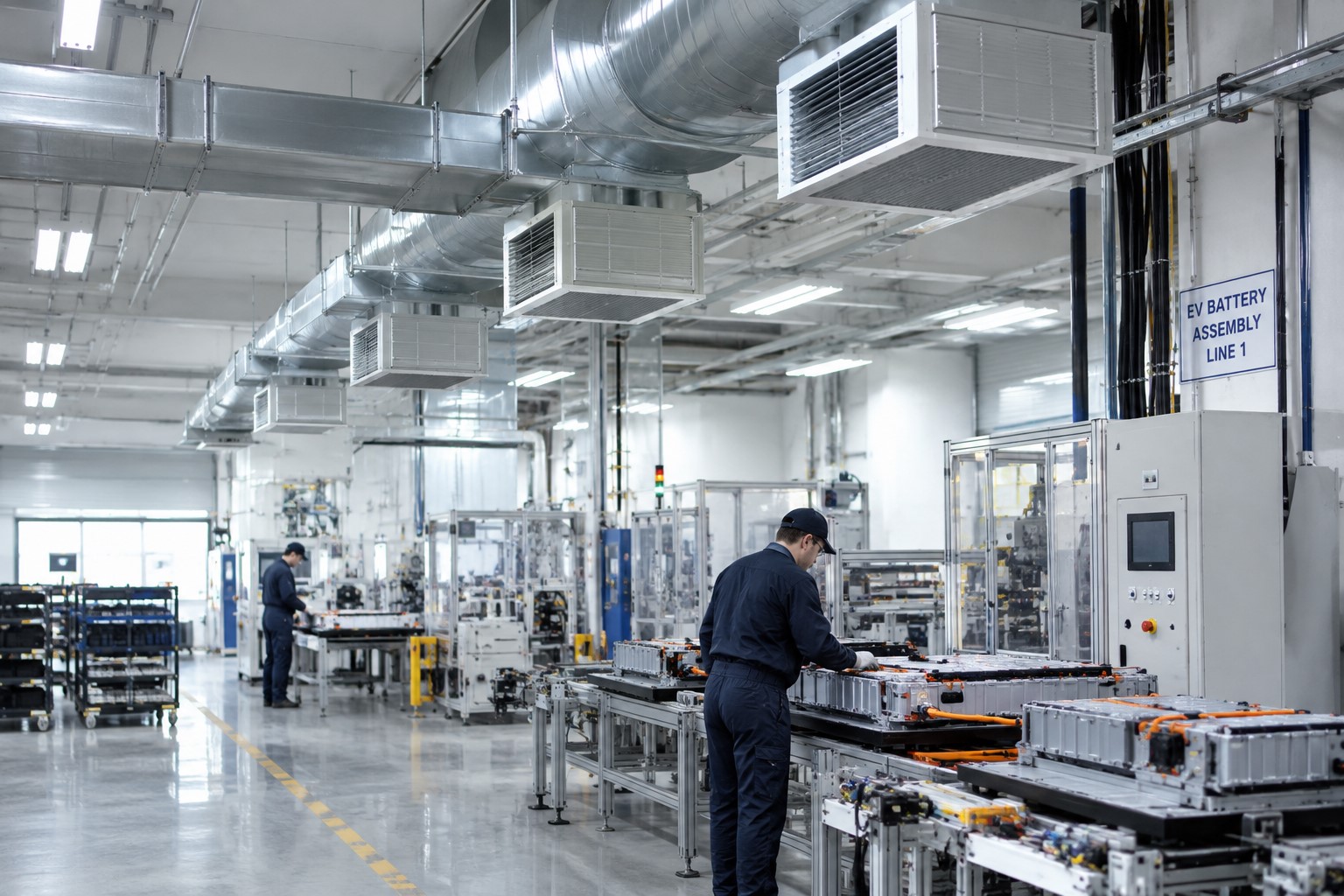
The manufacture of battery cells is a process that involves the preparation of electrodes, drying coating, filling of the electrolyte, assembly of the cells, formation, testing, and assembly of the packs. In the manufacturing process, heat, particulate matter, solvent vapors, and potentially dangerous gases may be introduced into the work environment.
Generally, lithium-ion batteries do not produce large amounts of hydrogen gas in normal operations, although abnormal conditions like thermal runaway could lead to combustible gases. IEEE/ASHRAE standards emphasize the importance of ventilation and temperature management, as well as battery technology and operational considerations.
Ventilation in an efficient factory is useful in:
- Maintaining good air quality in the facility
- Controlling process heat and humidity
- Eliminating fumes, vapors, and other airborne contaminants
- Avoiding buildup of any explosive gases
- Protecting the workforce and expensive machinery
- Maintaining controlled manufacturing facilities
- Maintaining consistent process conditions
Important Ventilation Considerations for EV and Battery Production Facilities
1. Process-related ventilation
Ventilation requirements vary depending on the manufacturing process and facility. While general room ventilation is sufficient in certain cases, processes that produce any contaminant will require LEV (Local Exhaust Ventilation).
LEV system extracts contaminants near the source, thus avoiding contamination of the production facility. The OSHA guideline on battery manufacturing shows an example of how source control, hoods, supply air systems, and controlled airflow are used as engineering controls.
2. Temperature and Humidity Control
Manufacturing of batteries may necessitate precise control of environmental conditions. HVAC systems could be required to control the temperature and relative humidity for quality reasons and to avoid problems associated with moisture.
Especially, such processes as electrode manufacturing and cell assembly could require dry-room HVAC systems or dehumidification. The exact limits for temperature and humidity should be defined based on the battery chemistry, materials, process details, and equipment requirements from manufacturers.
3. Management of combustible gases
During ventilation design, combustible gases that could be created during battery charging, abnormalities, or thermal incidents should be considered. Based on NFPA investigations and recommendations, combustion gases created during lithium-ion battery thermal runaway could vary considerably depending on chemistry and process conditions.
If there is a potential for combustible gas generation, the designers could implement gas detection, a ventilation system, proper fans and electrical equipment, alarms, and automatic controls. Ventilation design should prevent combustible gas accumulation rather than just use air change rate.
4. Dedicated exhaust systems
Air that is contaminated with anything should be appropriately vented, and it shouldn’t unintentionally spread into offices, cleanrooms, or any other production areas. Depending on the process, dedicated exhaust systems and filtration/treatment might be necessary.
Appropriate ventilation of battery systems may also require appropriate standards that include separate ventilation provisions and proper equipment in a potentially hazardous environment.
5. Airflow and pressure control
A properly designed HVAC system in a battery factory should create intentional airflow patterns. Usually, the air should flow from clean spaces into those having higher contamination risk, based on the specific process.
Pressure differentials, supply of air, exhaust vents, make-up air, and openings of doors should be considered together. Unbalanced systems might result in migration of contaminants, an unhealthy work environment, or poor exhaust capture.
Compliance and Safety Considerations
There is no universal ventilation rate that would apply to all EV and lithium-ion battery manufacturing facilities. Requirements depend on local building and fire codes, safety regulations, environmental requirements, battery chemistry, process hazards, and equipment.
For instance, OSHA standards for some battery systems highlight proper ventilation that would prevent accumulation of explosive gas mixtures. In India, it is necessary to review both national and local requirements in addition to project-specific standards.
A ventilation analysis should include evaluation of the entire facility, including battery manufacturing ventilation, industrial exhaust systems, clean rooms, dry rooms, thermal management, gas detection, fire protection, and HVAC controls – before finalizing the design of the system.
Conclusion
The requirements for the ventilation of electric vehicle and battery manufacturing facilities need to be specific based on the manufacturing process, battery chemistry, ambient conditions, and safety considerations. All the components of the ventilation system are essential in ensuring safety and reliability.
Marut Air supplies HVAC and air management solutions for industrial facilities and specializes in engineering environmental control systems. Its capabilities can assist any business with the evaluation of the correct ventilation and air conditioning solution for its manufacturing needs. The initial step in assessing the needs of an EV or battery manufacturing facility would be a process-specific HVAC and ventilation assessment. Contact Marut Air for your ventilation needs.
FAQs
What are the ventilation requirements for EV and battery manufacturing facilities?
These requirements depend on the chemistry of batteries, the manufacturing process, emissions, heat load, room configuration, and safety codes. The requirements can include general ventilation, local exhaust, process exhaust, dehumidification, or dry room HVAC.
Is there a need for ventilation of lithium-ion battery manufacturing?
Yes, manufacturing rooms have to be equipped with proper ventilation to maintain good air quality inside the room, control temperature, and deal with emissions of the process and any known safety risks. However, lithium-ion batteries cannot be assumed to always require ventilation of the same sort as vented lead-acid batteries – the ventilation has to be designed for the process and batteries in question.
What is a dry room in battery manufacturing?
A dry room is a special manufacturing facility with very low humidity. It is used when humidity may influence some of the battery components or the product itself. A dry-room HVAC system usually incorporates a number of different features, including dehumidification, airflow control, and filtration systems.
Is local exhaust ventilation necessary in battery production?
It may be necessary where a process produces some fumes, vapors, dust, or other substances. The local exhaust removes contaminants at or close to their source and may be more efficient compared to the use of general ventilation in that space only.
What is the proper design for HVAC systems in an electric vehicle battery production plant?
First of all, a hazard analysis must be done per process. Heat loads, contamination, humidity needs, airflow patterns, exhaust amounts, pressure relationships, gas hazards, filtration requirements, and code compliance must be determined. HVAC and industrial ventilation systems should then be combined with monitoring and safety controls.