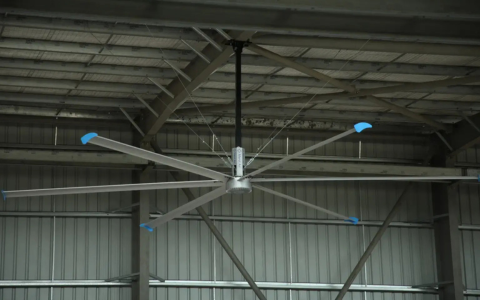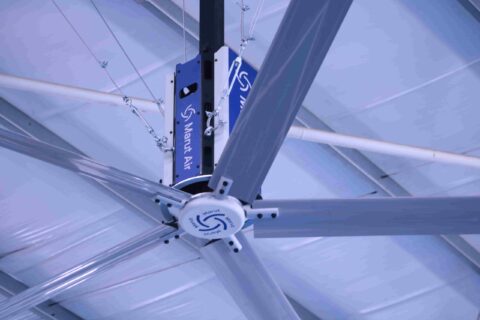

People purchasing airflow systems (HVAC, air conditioners, exhaust fans, etc.) usually focus on three things: The fan’s power, speed, and brand; however, most customers overlook the most important characteristic of airflow systems—CFM (Cubic Feet per Minute) measurement.
The CFM measurement is often an overlooked or poorly understood metric, yet it is one of the single best indicators of airflow performance. The purpose of this guide is to help the reader better understand: what a CFM measurement is, why it is important, and how to use CFM to maximise an airflow system’s efficiency.
Understanding CFM is quite simple—here’s the breakdown:
CFM = cubic feet of air moved in one minute (or the volume of air that an airflow system moves in one minute).
To put it simply, CFM tells you how much air is moving, not how fast it is moving. For example, a fan that has a CFM measurement of 16 will deliver approximately 16CFM of air every minute from the fan to the room in which the source air is located. A fan that has a CFM measurement of 18 will deliver approximately 18 CFM of air every minute from the fan to the room in which the source air is located and will be able to circulate more air throughout the room for greater air cooling and ventilation.
Why is CFM an overlooked measurement by so many buyers?
When shopping for an airflow system, the vast majority of people focus on the following three categories:
- A Fan’s RPM Rating
- A Fan’s Power Consumption Rating (watts)
- A Fan Brand Name
CFM gives a good indication of how effective an airflow system can be, but not necessarily how much air or how well a system distributes air. A high-speed fan can have a low CFM and comparatively poor performance because it has less overall airflow than a lower-speed fan with a higher CFM. The problem of underestimating CFM can most often come from:
- CFM is being used less frequently as a reference than speed and power
- Suppliers tend to accentuate obvious features (watts or speed) rather than what actually does what the consumer was looking for (CFM)
- The assumption that higher-wattage driven motors produce higher levels of performance than lower-wattage driven motors
When it comes down to it, CFM is the best measure of airflow performance; CFM is the most valuable and least commonly used measure for airflow.
How to Select the Appropriate CFM for Your Application
Once you understand the meaning of CFM, the question becomes one of knowing how many CFM you need. The selection of the proper airflow depends on factors such as size, use, occupancy, heat load, ventilation requirement, and equipment being used.
Typically, a small living area would require a different amount of airflow compared to warehouses, manufacturing plants, workshops, or other commercial buildings. Just selecting a fan with the maximum amount of CFM may not necessarily be ideal. The objective is to select an airflow that will work for your space.
Important Considerations for Selecting CFM
1. Size of the Space
As the size of the space increases, the volume of the airflow that is required increases as well. It is important to measure the length, width, and height of the space in order to determine the total volume of the space.
2. Use of the Area
Think about how the room is being used. A warehouse might need airflow to prevent heat accumulation, and an industrial building might need ventilation to get rid of fumes, dust, moisture, and other air pollutants.
3. Heat and Number of People
Heat can be generated by machinery, equipment, lighting, and people. Rooms with heat accumulation will need more airflow to ensure a comfortable work environment.
4. Airflow Obstruction
Various factors like ductwork, filters, bends, grilles, and others can obstruct airflow. Consequently, the claimed CFM of a fan doesn’t always guarantee the true airflow. When choosing the equipment, system resistance needs to be taken into account.
5. Energy Consumption
CFM is not always a good indicator of performance. Oversized equipment wastes energy and makes unnecessary noises or drafts. The perfect solution would be to have enough airflow that is efficient too.
Why CFM Is Critical to Your Decision-Making Process
If you understand CFM, you will greatly improve your ability to make decisions about systems that provide airflow.
- Improved Cooling Performance
With increased CFM, air coolers create better air movement (circulation) and therefore more consistent air conditioning for each area in your space.
- Energy Efficient
A system that uses the proper CFM will give you the desired cooling environment without requiring a great deal of additional energy to operate.
- Improved Air Quality
Properly distributing air from your system will aid in removing stale air, excess humidity, and pollutants, providing for a healthier indoor environment.
How CFM Works
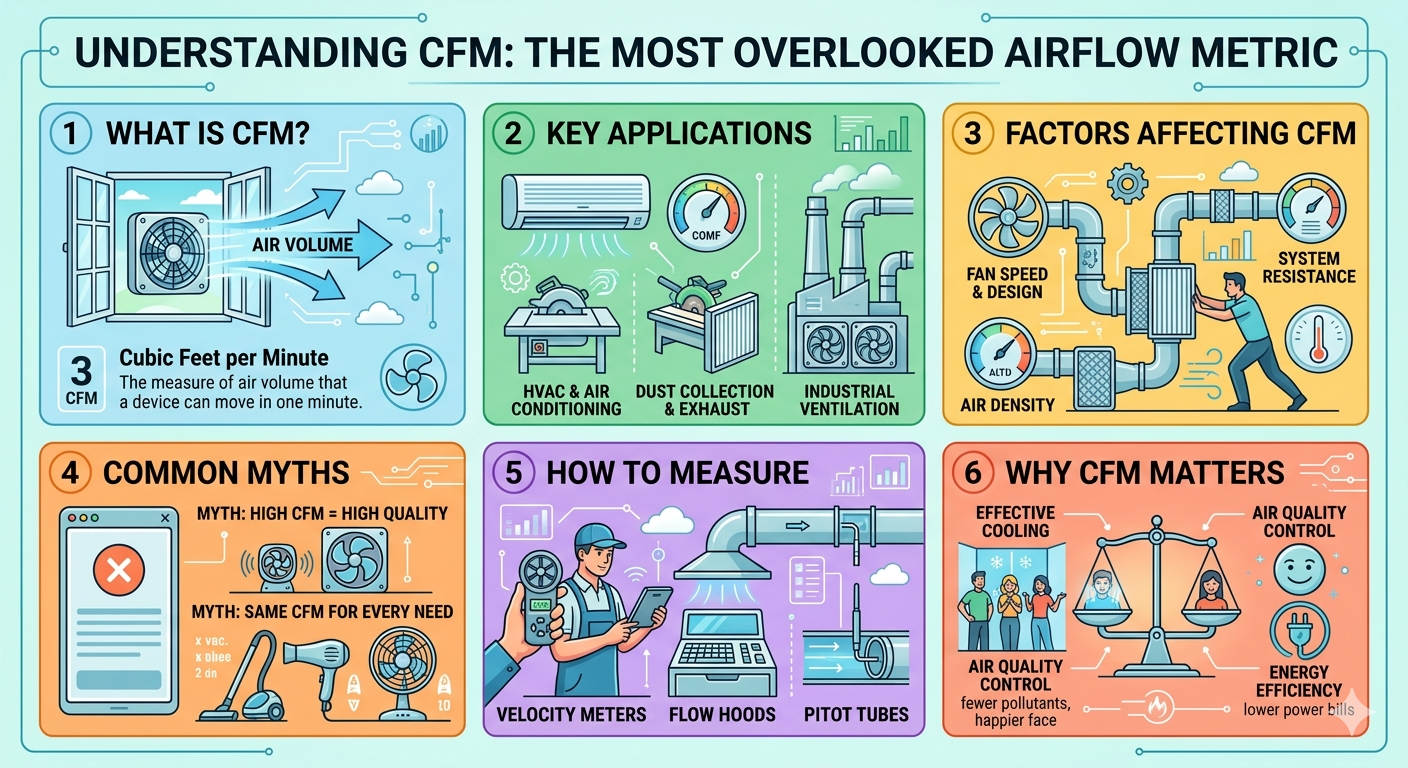
CFM (cubic feet per minute) measures the amount of air being moved per minute. The total CFM produced will be impacted by many variables such as the fan design, type of motor (power), and resistance of the system. Simply stated:
In an HVAC system, CFM will determine how effectively air will be distributed through the ductwork.
In an air-cooling application, CFM will define how much cooled air is produced to provide comfort.
The key idea is simple: more airflow = better coverage and performance (when balanced correctly).
CFM Calculation (Example)
CFM can be calculated using a simple formula:
- CFM = Air Velocity (ft/min) x Area (sq ft);
The units for air velocity and area must be consistent to get a CFM value. For example:
If the velocity of the air being moved through the duct, with an area of 2sq ft, is 500ft/min, then:
- CFM = 500 * 2 = 1000 CFM.
Recommended CFM for Room Size -> You must select the proper CFM to provide the desired airflow without wasting electricity.
| Room Size | Recommended CFM | Typical Application |
| Small Room | 50–100 | Bedroom |
| Medium Room | 100–300 | Living Room |
| Large Space | 300+ | Hall/Commercial |
CFM Application
CFM is a critical factor in how well HVAC systems distribute air throughout the rooms they serve. If the CFM is not sized correctly, it will cause discomfort or uneven temperatures.
Air coolers and fans use higher CFM to provide better cooling performance with greater volume or generally more volume ductworkand/or wide-open spaces.
In industrial applications, CFM is a critical factor in removing heat, fumes, and other contaminants from the work area, as well as complying with regulatory standards.
Airflow vs CFM
To make better choices, you need to know how CFM stacks up against other measurements.
CFM vs PSI: CFM is a measurement of volume, and PSI is a measurement of pressure. Both are important, but they are for very different purposes.
CFM vs RPM: CFM is a measurement of how much air you have, and RPM is a measurement of how fast your blower/fan runs. The higher the RPM, the more air you’re moving does not necessarily mean you’re moving the most.
CFM vs Air Velocity:
CFM = Total Volume of Air
Velocity = How fast the air is moving
CFM gives a more complete view of your system’s performance.
Better-performing: Your CFM is Too High or too low:
If your CFM is too low, you might experience:
- Poor cooling
- Uneven temperature distribution
- Decreased efficiency
If your CFM is too high, you might experience:
- Increased energy costs
- Noise problems
- Uncomfortable conditions due to excessive airflow
The objective is to find a balance, not to simply find the highest number possible.
If you understand and utilize CFM correctly, you can:
- Improve the efficiency of your refrigeration
- Decrease your electric bills
- Increase your comfort and the quality of your indoor air
Whenever you are selecting an air cooler, HVAC system, or Industrial Fan, CFM should be the primary deciding factor.

What are the Common Errors Associated with CFM?
Some of the common errors made by users are:
- Purchasing equipment without regard for CFM ratings
- Choosing items based solely on price
- Not matching the CFM of the fan with the area of the room
- Not considering the amount of resistance to airflow that exists in ductwork
Avoiding the above mistakes will significantly improve the performance of your system and the efficiency of your equipment.
How to Improve Airflow Without Changing Equipment
Here are some ways to improve airflow without replacing equipment
If your system is not working properly, you can increase airflow without replacing your current system by following the following steps:
- Clean your air filters regularly
- Clear any obstructions from vents
- Redesign ducts for better air movement
- Make sure installation is correct
Each of these simple actions will have a significant impact on your airflow.
Expert Suggestions for Improvement of Airflow
- Regular maintenance of your system is critical
- Balance airflow in all locations
- Do not overload systems
- Select correctly sized equipment
Improving your airflow will give you a better-performing system, reduce your expenses, and increase your equipment lifespan.
Conclusion: The Importance of CFM when Considering Air Flow
CFM is the most overlooked and critical measure of performance for any air-moving system. Most individuals will measure air velocity or horsepower, but in reality the true measure of system performance is how many CFM have been moved through the system.
FAQs for Cubic Feet per Minute: The Most Overlooked Airflow Metric
What is a good CFM for home use?
A small bedroom may require 50-100 CFM; a large living room would require anywhere from 200-300 CFM or more. Making sure to select the proper CFM will help ensure that you have good airflow, are comfortable, and are as energy efficient as possible.
Is higher CFM always better?
Yes, having high CFM ratings can help improve your airflow; however, having too high a CFM rating can create excessive noise, waste energy, and create discomfort. Each application requires proper CFM ratings to ensure that you achieve a balanced and efficient CFM performance.
How do I calculate the CFM required for my room?
You can determine how many CFM your area will require by multiplying the velocity of air moving through an area by the area of the duct or outlet; you can also estimate your CFM needs by using your room size, height of ceiling, and airflow requirements to calculate an amount based on ventilation.
What factors affect CFM performance?
Many factors affect how well your CFM performs in order for you to have maximum airflow. These include: motor design and efficiency; size of ducts; resistance to airflow; and maintenance of ducts and filters. Airflow can drop due to incorrect maintenance, such as dirty filters and blocked vents, so it is very important to take care of your heating and cooling systems to ensure optimal performance.
Can I improve CFM without replacing my system?
You can improve your CFM rating without replacing the entire heating, cooling, or ventilation system by cleaning filters or removing items that obstruct airflow through the ducts; sealing any leaks along the ductwork; and optimizing how your ducting has been installed. Regular and adequate maintenance will also create improvement in the overall working of your CFM.
Is CFM the only criterion I need to think about while purchasing a fan?
Not really. The CFM is important, but there are other criteria to think about, including static pressure, efficiency of the motor, design of the fan, noise, and others. A full consideration of the system will assist you in making the right decision.
Is the same CFM applicable in all industrial spaces?
Certainly not. All industrial spaces will differ in their airflow requirements. For example, a warehouse, a factory floor, a workshop, and an industrial space may require different CFMs due to their sizes and other factors. Thus, the proper airflow assessment is necessary before choosing a fan.