
The current needs of buildings require not only simple ventilation systems but smart systems that are able to react to changes in occupancy, indoor environment, and energy needs. In this case, inline fans, BMS, and DCV systems are an ideal solution. Classical ventilation fans worked at a constant speed without taking into consideration occupancy levels in rooms and actual needs for fresh air. The main advantage of these types of ventilation fans was the ability to work constantly, but there were significant drawbacks, including extra costs and inconsistency in the indoor environment.
In the contemporary world, the integration of automatic fans and building management systems offers facility managers the advantage of working efficiently through sensors and variable-speed technology. Buildings become able to ventilate rooms only when it is necessary. Now, let us find out how the work of inline fans correlates with the work of BMS and DCV systems.
What Is An Inline Fan and How Does It Operate?
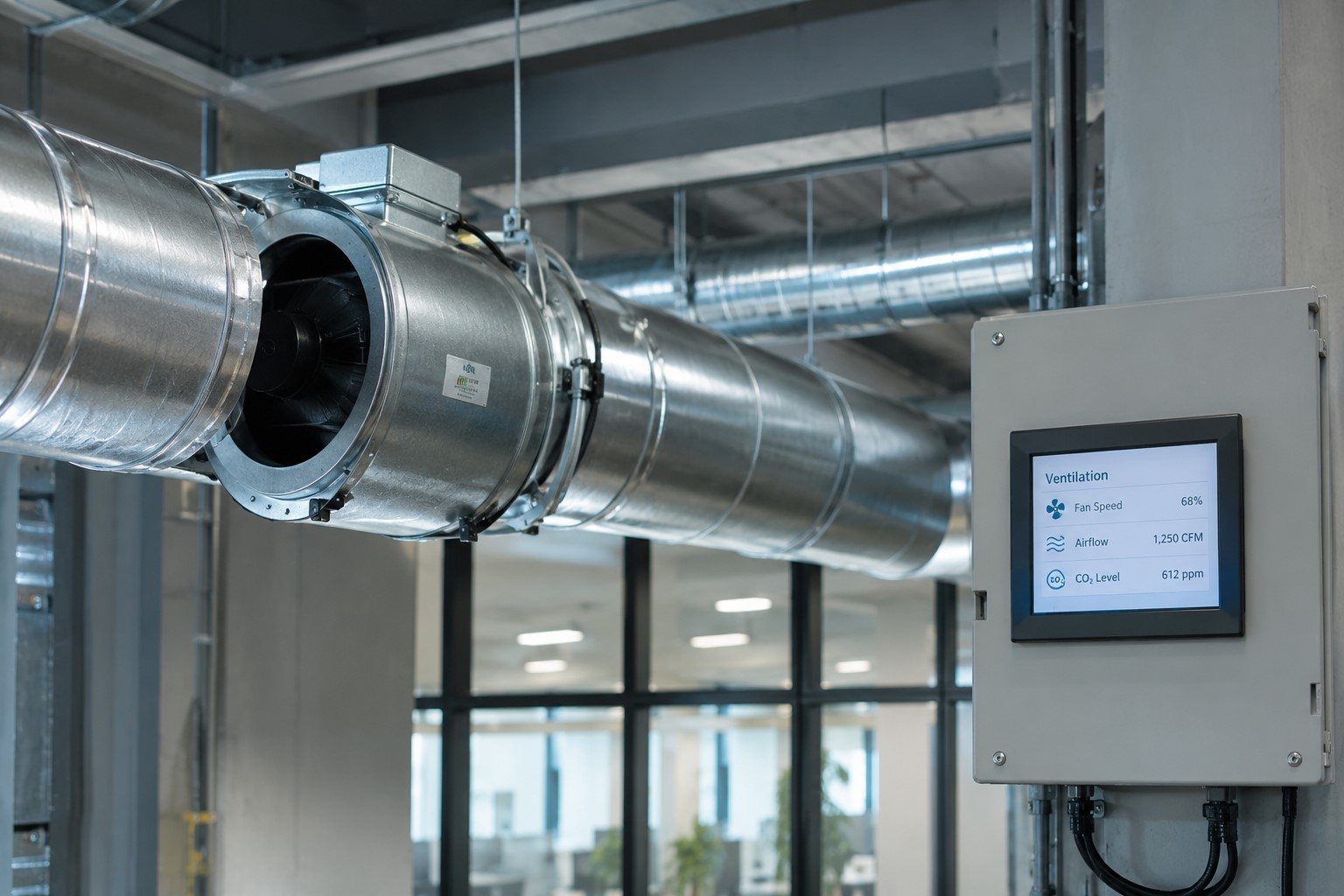
Inline fans are mechanical fans that are installed directly within a ventilation system to enable the movement of air from one area to another. Unlike ordinary fans, which are installed on walls and ceilings, inline fans are installed in ventilation systems and are therefore very suitable for cases that demand considerations such as space, quietness, and effective air circulation.
Inline fans are tasked with the responsibility of removing old air, eradicating bad odors, controlling humidity, and circulation of fresh air in the premises.
Inline fans are very suitable for the following scenarios:
- Office and corporate buildings
- Clinics and hospitals
- Kitchens and restaurants
- Industrial plants and factories
- Shopping malls, hotels and educational institutions
When fitted with automated controls, inline duct fans will be able to serve many other purposes besides moving air. In that case, they become an integral component of an intelligent building ventilation system.
Building Management Systems (BMS) Explained
Building Management System is a central control and management system for all essential building services, including HVAC systems, lighting, ventilation, security, and energy consumption.
In contrast to independent operation, a BMS connects various building operations under one control system.
By using inline fans in a BMS, building operators can:
- Check fan performance and operating conditions.
- Regulate ventilation speeds depending on building needs.
- Schedule fan operation taking into account occupancy and working schedules.
- Get notifications in case of abnormal operation or failures.
- Coordinate ventilation operation with the heating/cooling systems.
- Calculate energy usage and optimize it.
For instance, during workdays, a certain amount of ventilation is needed for an office building, and less at night when all workers have already left. A BMS would allow setting up the operation of inline fans accordingly.
This allows not only to improve the efficiency of building operation but also to provide an appropriate indoor environment.
How Inline Fans Contribute to DCV Systems
Demand-Controlled Ventilation (DCV) is a process of ventilation that adjusts the flow of air according to demand rather than operating on a certain schedule.
The DCV system uses sensors to know when and where extra ventilation is needed.
There are some kinds of sensors, such as:
- CO2 sensors monitor how much CO2 is present in the air in terms of required ventilation.
- The occupancy sensors sense if there are any people occupying that particular space.
- The humidity sensors sense the levels of humidity in the air.
- The air quality sensors sense the air quality parameters present in the air.
Based on all this data, the control system will give signals to the respective inline fans to regulate their speed for proper airflow.
For example, the CO2 level may rise when a conference room gets overcrowded. The DCV system can compensate by providing increased ventilation. When there is no one in the room and the air quality returns to an ideal state, it is possible to reduce the speed of the fans.
This is done using inline fans for demand-controlled ventilation that ensures the right balance between indoor air quality, comfort, and energy consumption.
Main Advantages of Combining Inline Fans with BMS and DCV
Combining smart ventilation controls with inline fans provides some benefits.
1. Increased Energy Efficiency
Energy savings are one of the main advantages. It is unnecessary to run fans constantly at full speed.
It will help avoid unnecessary fan activity and, where the ventilation load impacts the heating and cooling requirements, help reduce HVAC energy usage.
2. Improved Indoor Air Quality
The ventilation system helps to remove pollutants, humidity, odors, and stale air from the premises. If the sensors have access to the ventilation system, airflow can be regulated.
However, CO2 monitoring is supposed to act only as a ventilation indicator, which is related to the number of people in the premises and not as a guarantee of good air quality.
3. Automatic Control and Monitoring
Using the BMS system, facility managers will be able to monitor the functioning of the ventilation machinery from one single place. This will help them identify faults in equipment functioning, inspect fan operation, and make changes in the settings.
4. More Comfortable Occupants
Different parts of the facility require different ventilation standards. Meeting rooms, washrooms, kitchens, and industrial premises do not require the same airflow throughout the day.
Ventilation control with the zone approach allows inline fans to operate according to the needs of the specific space.
5. Smart Building Management
Combining ventilation with other HVAC units makes it possible for building managers to synchronize airflow, cooling, and air distribution more efficiently.
What Are the Things to Consider Before Adding Inline Fans to BMS?
Successful integration involves more than just connecting a fan with an automated controller. Some technical issues are worth considering:
- Compatibility of motor: Purchase inline fans that have compatible EC motors or VFD configurations depending on the need for speed control.
- Control protocols: Determine whether the fan controller is able to communicate or interact using the desired protocol, for example, 0–10V, BACnet, or Modbus, among others. Not all such protocols are always interchangeable and may need additional interface hardware.
- Sensor location: Proper sensor location to ensure correct measurement is needed for CO₂, humidity, and occupancy sensors.
- Airflow calculation: Determine airflow needs from the size of the room, number of people, duct resistance, and ventilation code requirements.
- Regulations: Ensure that the ventilation requirement is satisfied and proper fire and smoke control systems are in place wherever required.
- Maintenance: Check filters, ducts, motors, sensors, and control interfaces.
India’s Energy Conservation and Sustainable Building Code 2024 includes provisions for demand-controlled ventilation and also makes provisions for some specific requirements for this in mechanically ventilated spaces.
Conclusion
Inline fans, along with BMS and Demand-Controlled Ventilation, are paving the way for smarter and more efficient ventilation for buildings. Selecting the appropriate fans, sensors, and automation controls will enable businesses to get better ventilation management while ensuring a comfortable indoor environment and energy-efficient operations.
In search of reliable ventilation systems? Marut Air provides you with a range of ventilation products for various commercial and industrial uses. Discover the wide range of inline fans provided by Marut Air and choose the ones that meet your requirements. Get in touch with Marut Air and learn more about ventilation solutions for your building.
FAQs
Can inline fans be integrated with a BMS?
Yes. Fans that can be used with a BMS can be connected through sensors, control interfaces, and automation controls. This may depend on the fan motor and the controller. 0-10V, relays, or BACnet and Modbus communications can be used for this purpose.
What role does demand-controlled ventilation play in inline fans?
The system utilizes sensors to determine occupancy and the condition inside the building. The controller receives data from the sensors and regulates the speed of compatible inline fans to deliver adequate airflow rather than keeping fans running all the time at full speed.
Can inline fans lower HVAC energy consumption?
Yes. With proper speed control settings, inline fans reduce unnecessary ventilation when there is no demand. Additionally, they are able to reduce the energy used to heat and cool the additional outside air ventilation.
What type of sensors are used in combination with inline fans in the DCV system?
Examples of sensors that can be used with inline fans are CO₂ sensors, occupancy sensors, humidity sensors, and indoor air quality sensors. Depending on the use of the building, the need for ventilation, and what kind of pollution the sensor will detect.
Are inline fans suitable for commercial and industrial buildings?
Of course, they are. Inline fans are suitable for different types of buildings, including offices, hospitals, hotels, restaurants, warehouses, and industrial buildings. This will depend on the required airflow, ductwork, and fan characteristics.