
How to Choose the Best Axial Fan for Industrial Ventilation – It is an indispensable aspect of maintaining good air quality, managing heat, exhausting fumes, and making the work environment safe. However, the process of choosing the right fan cannot be reduced to choosing the unit that has the biggest airflow capacity. The right axial fan should perfectly correspond to the airflow requirements, the static pressure, the conditions of operation, the space available, and the energy needs of your facility.
Axial fans are popular because they can provide high airflow rates despite their relatively small size. Here is what you need to do to choose the right axial fan for your particular application.
What is an Axial Fan?
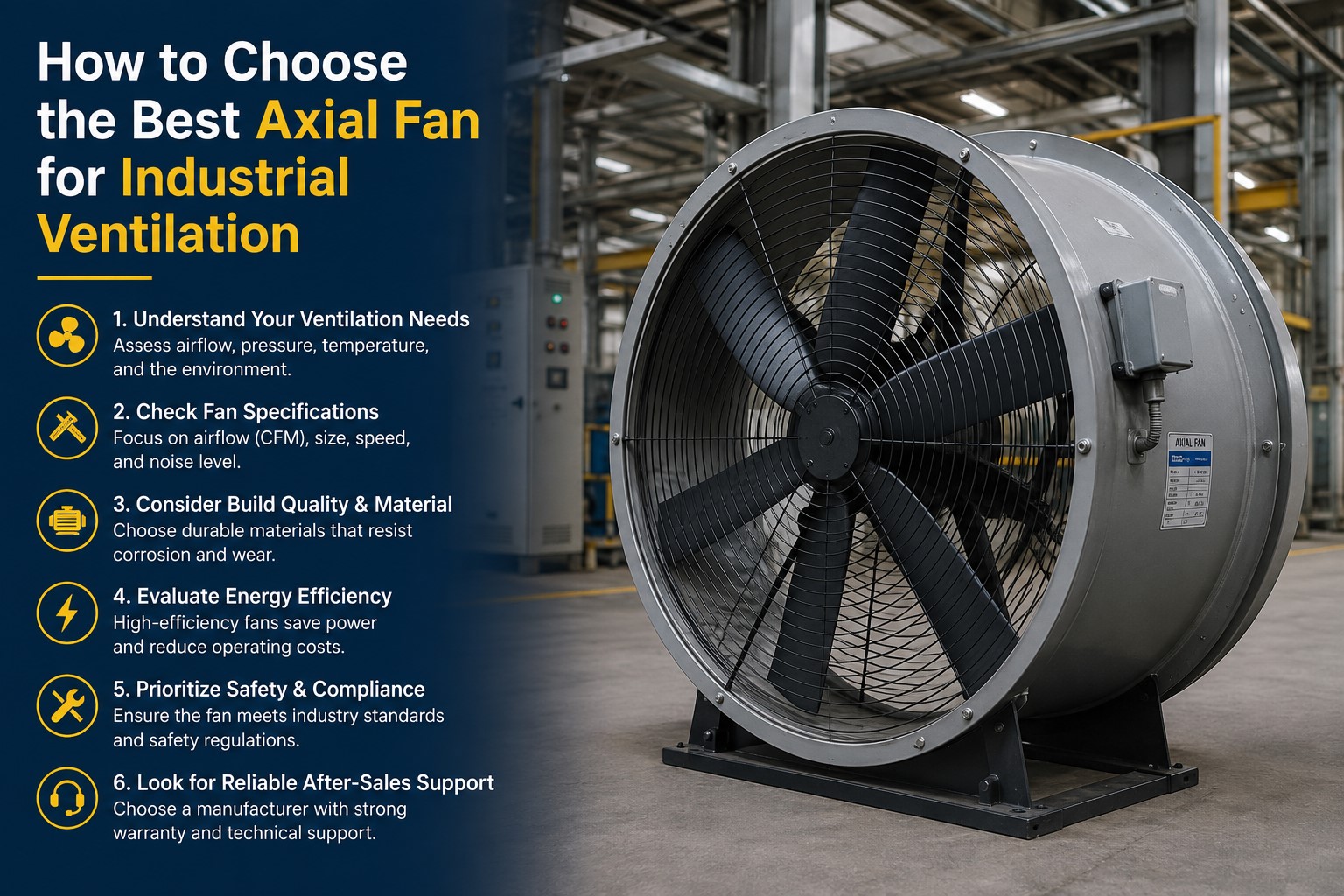
An axial fan delivers airflow along the axis of the fan shaft. As opposed to centrifugal fans that deviate airflow via the blades, axial fans have relatively direct flow of air. This is the feature that makes them quite efficient in cases where high airflow with low system resistance is required.
Industries where axial fans can be utilized include factories, warehouses, workshops, manufacturing plants, agricultural industries, and commercial spaces.
Features To Consider When Choosing the Best Axial Fan for Industrial Ventilation
1. Determine the Amount of Airflow Needed
Begin by figuring out how much air you need to move in your facility. Airflow is usually measured in CFM (cubic feet per minute) or m³/h (cubic metres per hour).
To determine the minimum amount of air needed for proper ventilation, you can use one of the following calculations, where room volume is multiplied by air changes per hour:
Required airflow = Room volume × required ACH
For instance, if your facility has a volume of 1,000 m³ and requires 10 air changes per hour, then the needed airflow would be approximately 10,000 m³/h.
ACH varies depending on the application, heat load, contamination level, occupancy, and ventilation system used. Thus, use this formula just as a starting point and not an airflow figure.
2. Measure Static Pressure
Airflow is not enough to ensure fan performance. Static pressure means the resistance that the fan will encounter during the process.
Components such as ducts, filters, dampers, louvers, bends, grilles, and many others reduce the real value of airflow. A fan with impressive free-air CFM may perform significantly lower when installed in a restrictive ventilation system. Thus, selection of fans should be made taking into account the fan’s performance chart according to the specified airflow and static pressure values.
3. Select the Right Kind of Axial Fan
Certain kinds of axial fans are better suited to certain applications than others.
| Fan Type | Typical Application | Main Advantage |
| Propeller Axial Fan | Open areas, wall exhaust, general ventilation | High airflow and simple installation |
| Tube Axial Fan | Ducted industrial ventilation | Compact, straight-through airflow |
| Vane Axial Fan | Higher-pressure duct applications | Better pressure capability |
| Inline Axial / Mixed-Flow Fan | Long or restrictive duct systems | Good airflow with improved pressure performance |
An axial fan might not always be the most effective choice if there is a lot of resistance in the system. Other types of fans, like centrifugal or mixed-flow, might be more appropriate.
4. Consider the Air Quality
Air quality characteristics are important. There is a difference between clean-air ventilation and applications that involve dust, moisture, corrosive gases, high air temperatures, or process fumes.
Before choosing the industrial axial fan, it is necessary to evaluate the air temperature, humidity level, contaminants, and corrosive materials. Materials of construction, motor capacity, bearings, and protective measures should be matched with the environment.
5. Assess Motor and Energy Efficiency
A fan runs for thousands of hours and, thus, the energy usage must be taken into account along with its cost of purchase. The fan must have an energy-efficient motor and should be selected with regard to being near its duty point and not oversized.
Variable frequency drives may be used as additional means of speed regulation in cases where there is a change in ventilation demand. According to fan affinity laws, flow varies directly proportional to the speed, while the pressure varies by the square of the speed and power by approximately the cube of speed.
6. Examine Noise, Installation, and Maintenance
Noise may be an essential factor in industrial occupied buildings. Pay attention to the manufacturer’s noise characteristics as well as the fan speed, blade configuration, mounting, vibration isolation, and ducting system.
Installation needs should be taken into account before buying a fan. It is necessary to confirm the opening or duct diameter, mounting position, electrical supply, maintenance needs, and needed safety devices.
The maintenance of such practices as cleaning, inspection, lubrication where needed, and testing of the motor can also assist in maintaining good performance of ventilation over the fan’s lifetime.
A Simple Checklist to Select an Industrial Axial Fan
Before purchasing, collect the following specifications:
- Airflow requirement: CFM or m³/h
- Static pressure requirement: Pa or mmWG
- Air temperature
- Air composition and contaminants
- Fan size and installation space available
- Motor power, voltage, frequency, and phase
- Noise requirement
- Operating hours
- Control requirement, especially compatibility with VFD
- Service and maintenance requirements
Above all else, match the required operating point with the fan performance curve provided by the manufacturer. A correct fan selection involves an intersection of the fan performance and the system curve, rather than just the highest airflow mentioned in the catalog.
Conclusion
Selection of the best axial fan for industrial ventilation cannot be done only by looking at CFM. Airflow, static pressure, working conditions, fan type, motor efficiency, installation requirements, and performance curves are key factors to take into account.
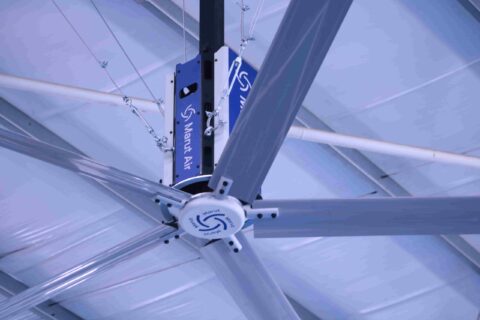
Marut Air manufactures ventilation systems such as industrial exhaust fans, HVLS fans, and various air movement systems suitable for use in big areas. The company’s approach revolves around application-specific, energy-efficient ventilation systems for industrial and commercial settings.
FAQs
What is the role of static pressure while choosing an axial fan?
The static pressure takes into account the resistance offered by the ductwork, filters, dampers, bends, grilles, and other components. Overlooking static pressure may cause you to end up with a fan that produces high airflow but cannot supply enough air when installed.
Is it true that the bigger axial fan you choose, the better?
Not necessarily. This is because oversizing may lead to increased purchase costs, energy consumption, and noise. The objective is to choose the fan that works efficiently at the duty point required.
Difference between axial and centrifugal fans?
An axial fan is a type of fan that blows air along the axis of rotation and is suitable for moving large volumes of air with low static pressure. Centrifugal fans move air in such a way that its direction is changed in the passage of the impeller, and they are preferred where high static pressure is needed.
Can an axial fan cool an industrial plant?
Yes. The axial exhaust and ventilation fans can expel hot air and create circulation of fresh air. The number, size, and location of the fans have to be decided considering the heat load and ventilation requirement of the facility.
What data must I give the fan manufacturer?
You need to give the fan manufacturer information about airflow, static pressure, air temperature, air quality, installation configuration, power source and running time, and any other space restrictions or requirements related to noise or control of the fan.