
Have you ever been to a densely populated event at an auditorium and wondered how you stayed at a comfortable temperature with hundreds of people packed around? The most likely answer- a silent, spinning fan just above your head. Auditorium spaces offer their own special set of air conditioning and cooling challenges- high volumes to circulate through enormous buildings with high ceilings to keep heat trapped in- audiences who have minimal tolerance for disturbance when watching a lecture or performance.
Conventional air conditioners sometimes can’t maintain appropriate conditions in auditorium settings or make excessive noise during an important event. Luckily, HVLS fans for auditoriums can!
What Makes HVLS Fans Different From Standard Fans
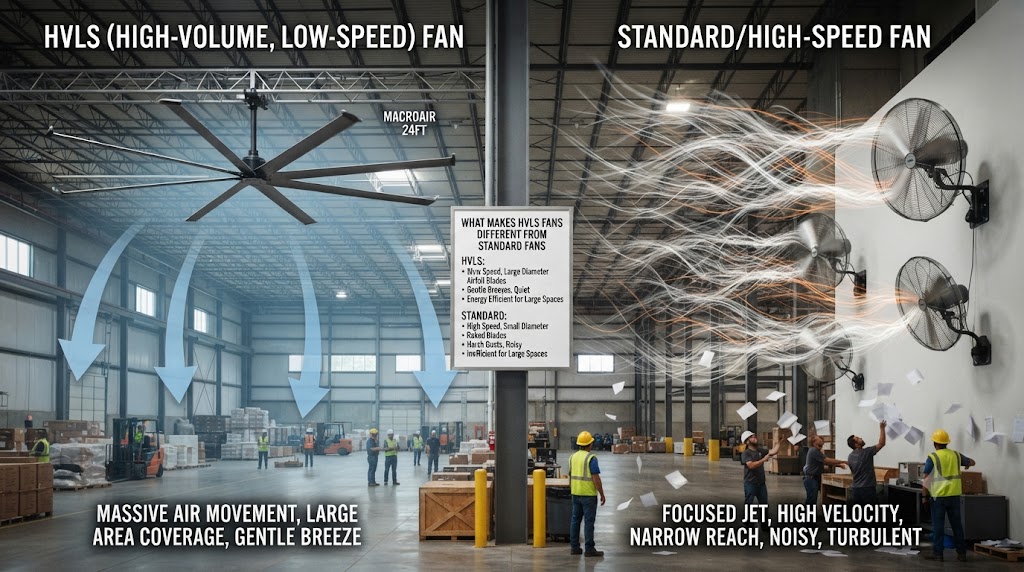
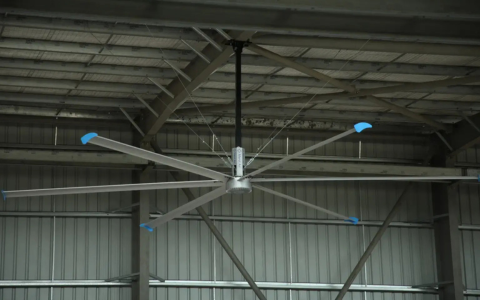
HVLS is an acronym that means “High Volume, Low Speed.” Unlike your regular ceiling fan or pedestal fan that goes so fast, only moving a relatively small amount of air in a small space, an HVLS fan typically has huge blades (anywhere from 8-24 feet in diameter) moving incredibly large volumes of air, just slowly. This way, not only is massive air movement created, but the draft isn’t uncomfortable and turbulent, which happens at much higher fan speeds. Soaring auditoriums and large floor plans are the perfect conditions for this approach.
Why Auditoriums Struggle With Heat and Air Stagnation
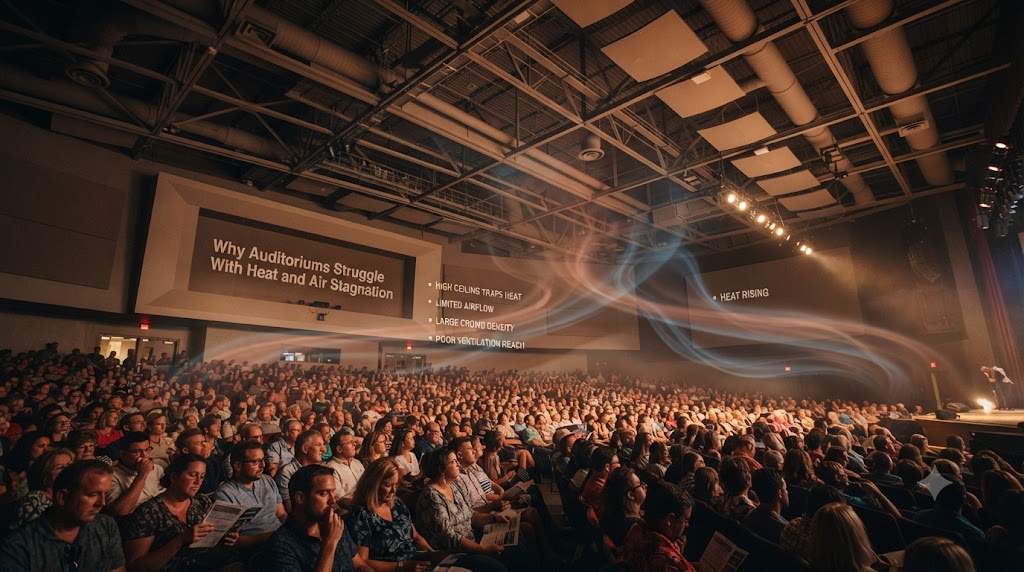
Auditoriums face unique thermal problems. Since heat tends to rise and gather near the high ceilings-a phenomenon called “thermal stratification”-it stays warm and uncomfortable near the ground level-where the audience members actually sit-because the air simply does not circulate well. The combined effect of people emitting heat, stage and light equipment radiating heat-and not to mention, human body heat-makes for a stinking hot auditorium. A normal air conditioning system often experiences problems like it cannot push down cold air enough to such a vast space and that the energy is being wasted as there are cooler pockets of air near the ceiling.
How HVLS Fans Solve the Cooling Problem

HVLS fans address this directly by keeping the air within the auditorium constantly circulating and mixing. When the HVLS fan is in operation, the blades churn down a column of air that distributes along the floor, rises around the walls of the auditorium, and makes its way back to the fan and then down through another column once it reaches the middle of the floor space. The circulation is slow, steady, and effective enough to eliminate stratification and return the “stagnant” warm air back into circulation.
This keeps the temperature consistent throughout the auditorium and ensures the temperature is even from the first row to the last row, and floor to ceiling. This further ensures that air conditioning systems do not have to work so hard.
Why Quiet Operation Matters in Performance Spaces
When the focus should be on speeches, performances and presentations, sound has to be kept at an absolute minimum. Traditional cooling fans can sometimes generate a consistent humming and whirring sound that can be truly irritating at certain moments. This problem has been designed out of HVLS Fans; these operate at very slow rotations and consequently make little noise at all.
Many of these fans are specifically designed for sound critical venues and will be ideal for concert halls, lecture theatres, and banquet halls, where every single utterance or note will carry more importance to the guest. Guests and occupants can still enjoy fresher air and added comfort without really ever hearing the fan at all.
Energy Efficiency Benefits for Large Venue Owners
Beyond comfort, HVLS fans provide practical savings for venue owners. By greatly increasing air movement throughout a space, HVAC units can do less work, thus saving significant money on energy consumption in the long run, particularly in spaces used throughout the year. They also use less electricity on average than the amount of electricity used by multiple small fans of an equivalent total size (a single large HVLS fan can cool the space of many smaller ones). This can help save an auditorium owner’s operating budget while guest comfort remains high.
Choosing the Right HVLS Fan for Your Auditorium
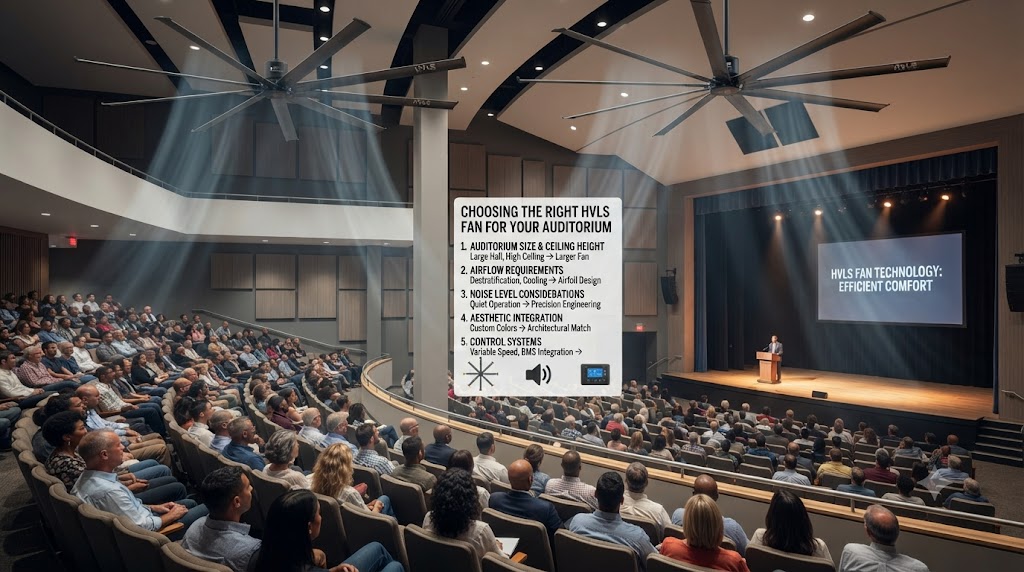
Each HVLS fan will vary and your ceiling height, square foot area of space and the type of airflow needed will determine the fan that would suit your venue best. There are many varying aspects to an HVLS fan and the blade diameter, motor power and installation mounting height will all affect its performance and capability. Your sales provider will make sure that the fan is the correct size and installed appropriately to meet the most desirable result.
Final Thoughts
Big auditoriums are tricky to temperature and still keep comfortable, they need to provide an environment where focus is placed firmly on the event, not the heat and noise surrounding it. HVLS fans are a proven, energy saving way to maintain movement and a peaceful sound without adding to heat. At Marut Air, our expertise lies in specifying and installing suitable HVLS fans to fit any auditorium, ensuring comfort that is always appreciated but not noticed.
FAQs
Q: Will an HVLS fan actually make a difference in a space as big as an auditorium?
Yeah, and actually, that’s what they are good for. Instead of regular fans blowing a tiny radius of air around your head, HVLS fans blow great big columns of air over and out throughout the whole floor. In a building with high ceilings and hundreds of seats, that’s what you need to actually push the air out around instead of letting them be hot spots.
Q: I’m worried about noise during performances. Are these fans really that quiet?
Probably the #1 concern anyone with an event space has and rightfully so. The slow rotation of HVLS fans does not generate the annoying whine or buzz of most smaller, faster fans. Your patrons are probably not going to even realise the fan is running and this is a benefit not a nuisance.
Q: Can this replace my air conditioning system, or do I still need both?
Essentially, think of it as two working partners rather than substituting one out for the other. Your fan just circulates the air, it cuts through the warm layer of stagnant air just under the ceiling and drives it downward. The air conditioning system is the part doing the real cooling and the air conditioner will need less time running at full power so that this change may reflect itself in the power bill.
Q: How do I know what size fan my auditorium actually needs?
That is entirely dependent on the dimensions (specifically ceiling height and square footage you’re aiming to cover) of the venue. A fan that’s sufficient for a medium-sized lecture hall simply won’t cut it for a full-size arena. Have an engineer size your fan for you; don’t guess; a too-small fan won’t be beneficial to you.