
Keeping the air fresh in large spaces like warehouses, factories, and workshops is very difficult. The environment quickly becomes hot and stuffy while running heavy machinery for a long time in a space with limited airflow. That’s where industrial fans become an effective solution for maintaining consistent airflow across large spaces. Big industrial fans help save energy, move fresh air across wide areas, decrease heat buildup, and improve air quality in the spaces. Proper airflow is important for both workers’ comfort and machinery efficiency, whether it is in factories, warehouses, or workshops. Industrial fans also offer smart and energy-efficient solutions. In this guide, you will learn how big industrial fans help save energy and enhance overall performance in large spaces.
What Are Big Industrial Fans?
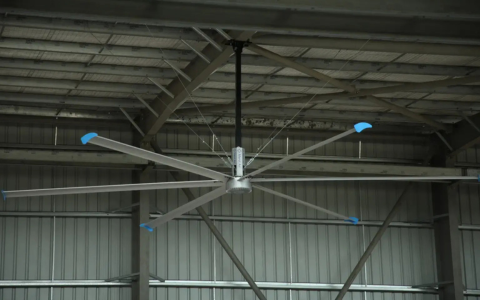
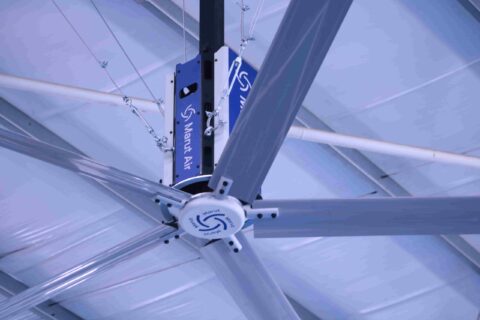
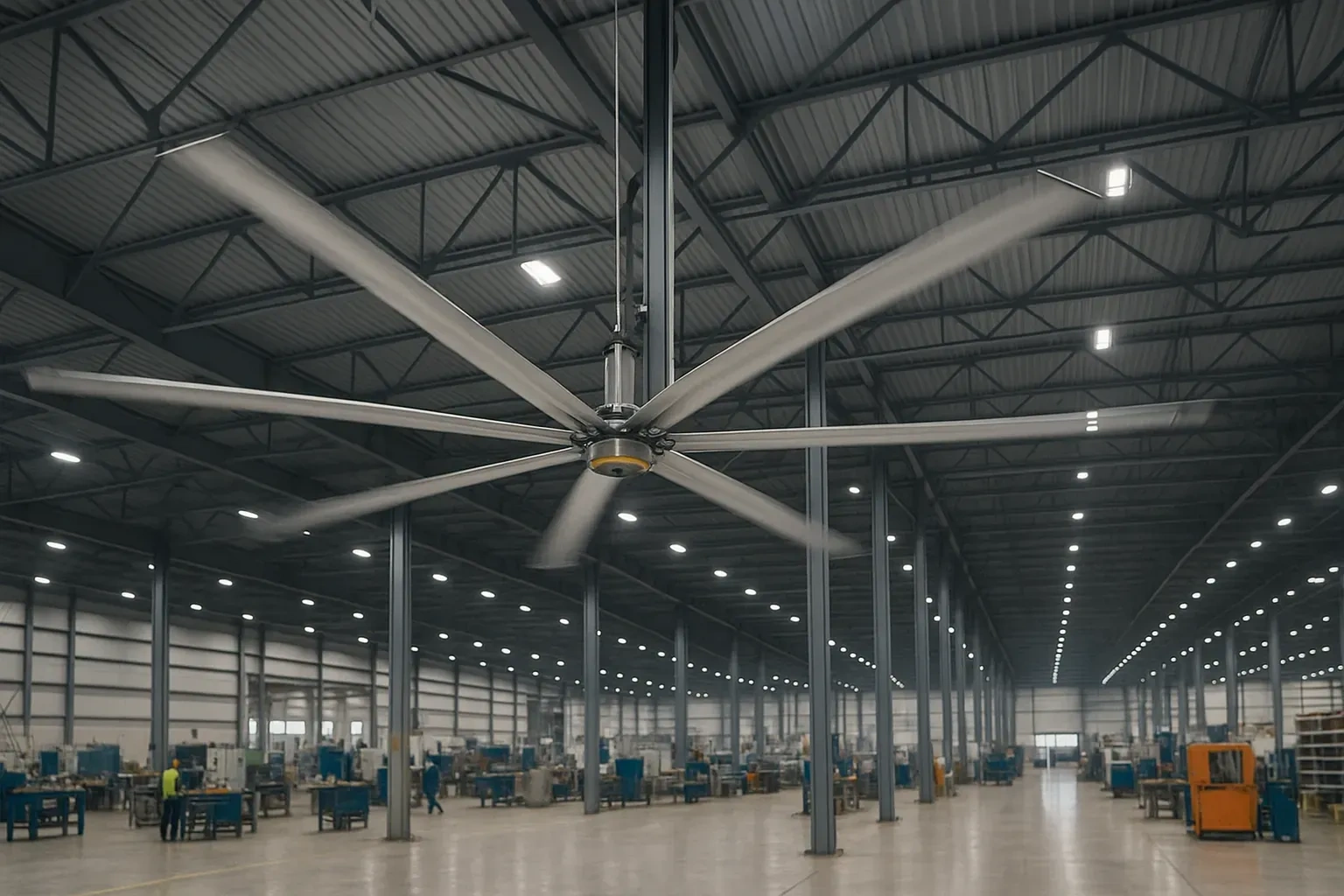 Big industrial fans are also known as HVLS (High Volume Low Speed) fans. They are designed to move massive volumes of air at low speeds while consuming less electricity. They work on the principle of advanced fluid dynamics. Unlike small fans, they not only create airflow, but they also circulate a massive amount of air across the entire space. It reduces the air resistance, which enables them to distribute air more smoothly and efficiently.
Why are HVLS fans more efficient?
- They move large volumes of air using less energy.
- They decrease the requirement for multiple small fans.
- They offer low operational costs over time.
- They create uniform airflow in the space.
Why Do Large Spaces Face Energy Challenges?
Large spaces like warehouses, factories, or workshops face energy challenges due to these things:
- High ceiling in the building.
- Poor air circulation in the spaces.
- Uneven temperature distribution in the space.
- Overdependence on HVAC systems.
How Big Industrial Fans Save Energy in Large Spaces?
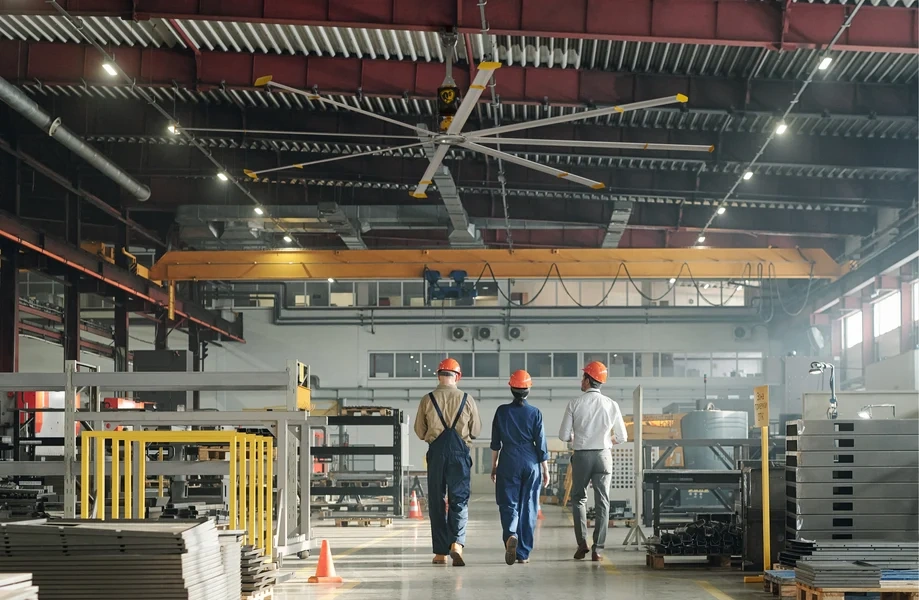
Big industrial fans like HVLS fans are especially designed to enhance the airflow in spaces and decrease the load on the cooling and heating system. They make the entire space more comfortable by using smart air movement. These are the steps for saving energy:
1. Improved air circulation:
Industrial fans enhance the quality of air in the large space. It helps to remove airborne heat and improves overall air so people can work comfortably without any illness, using the continuous rotation and circulation of airflow. It reduces humidity and maintains a fresh environment in the space. As a benefit, you don’t need to run the air conditioning at full speed all the time.
2. Reduce reliance on the HVAC system:
Large buildings heavily depend on the HVAC system, which consumes a lot of energy. Big fans improve airflow, which allows heating and cooling systems to work more efficiently. Big fans act as a complementary solution by reducing the workload of this system. It extends the lifespan of HVAC equipment and also translates into lower energy consumption and operational cost.
3. Destratification:
We all know that, due to thermal stratification, warm air rises and gets trapped near the ceiling in large spaces. But industrial fans fix this with the destratification process. It maintains the uniform temperature in the entire space, so you don’t need to run the heating system overtime.
4. Evaporative cooling effects:
Industrial fans create a gentle breeze, which can support evaporative cooling. It helps by evaporating sweat faster from the skin, so people can feel cooler at the same temperature. In that condition, you can change the thermostat setting, and you still feel comfortable. By this, you save significant energy.
5. High efficiency with low power consumption:
HVLS fans work on the fluid dynamic principle, which moves a large volume of air with minimal resistance. They use less energy than multiple small fans.
What are the key benefits of using big industrial fans?
Big industrial fans provide various benefits, such as
- Improves air circulation across the entire space.
- They reduce energy consumption and electricity bills in the industry.
- They require low maintenance costs and have a long lifespan.
- They help to improve worker comfort and productivity.
- They enhance cooling by evaporative cooling.
- They maintained a uniform temperature in the entire space.
What are the common mistakes to avoid?
- Try to cover a large area with a few big industrial fans.
- Incorrect placement of industrial fans.
- Skipping regular cleaning and maintenance of fans.
- Choosing low-quality and cheap fans for your space.
- Ignoring the requirement of ceiling height.
- HVAC systems are not integrated with fans.
Conclusion:
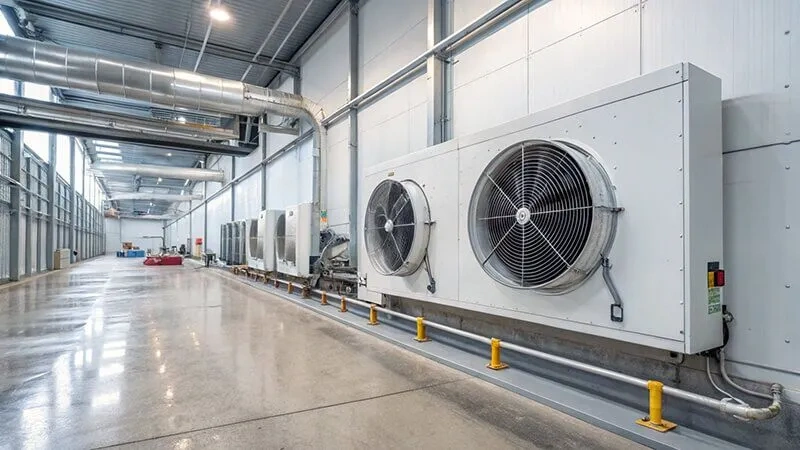
Investing in high-quality industrial fans can reduce energy costs, improve air circulation, support HVAC systems, and maintain a comfortable environment in your spaces. If you use big industrial fans in your large space, it saves your business costs and makes them energy efficient and eco-friendly. If you are looking to manage your electricity bills and enhance overall performance, then install big industrial fans in your large space. Choosing the right industrial fans with better sizing and placement can maximize energy saving and performance.
FAQs Regarding Industrial Fans Help Save Energy in Large Spaces:
Q1. How much energy can big industrial fans save?
Ans: Industrial fans like HVLS fans can reduce energy use by up to 30% by reducing the load of the HVAC system. But the saving of energy depends on the size of the space and usage patterns.
Q2. Do big industrial fans require a lot of maintenance?
Ans: No, they do not require a lot of maintenance; they run effectively if you do regular cleaning or occasional inspection, because they are low-maintenance technology.
Q3. Are industrial fans better than air conditioning?
Ans: No, it is not a replacement for air conditioning. They are designed to work alongside the HVAC system to improve energy efficiency, improve airflow, and reduce overall cooling costs in the large space.