
For the vast majority of businesses, one of the biggest and most exciting milestones will be the expansion of a manufacturing plant. Expanding a manufacturing facility typically represents an increase in productivity, an increase in income, and an increase in demand for the products being produced. Sadly, however, many manufacturers concentrate only on machinery, shop floor area, and workforce expansion, while failing to properly address an extremely important factor – the ventilation system of the manufacturing facility.
Inadequately planned ventilation systems in expanded manufacturing facilities can provide manufacturers with high energy-related costs, overheating equipment, decreased worker production levels, and costly retrofit of systems, among other issues. Conversely, a well-designed ventilation system can provide manufacturers with increased occupational safety, reduced maintenance costs, and lengthy operational lives of equipment.
If you are a manufacturer currently planning to expand your facility, here is an outline of some practical ventilation checklists that you can implement as part of your expansion plan that will prevent costly mistakes in your facility and save your manufacturing company a considerable amount of money in the long run.
In this blog, we will talk about the Factory Expansion. Here’s the Ventilation Planning Checklist That Can Save You Millions
The Importance of Ventilation in Your Expansion Project
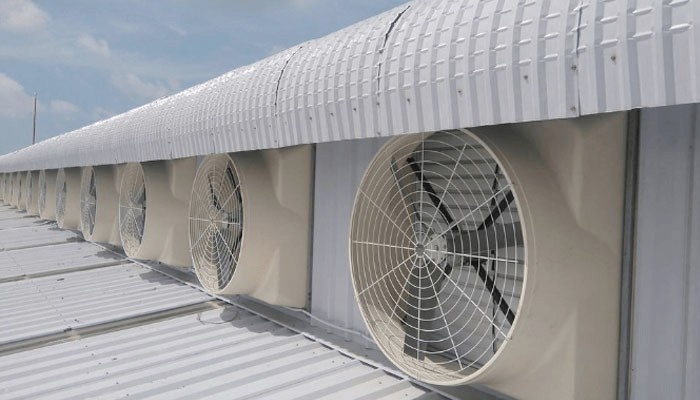
With an increase in the amount of production and output from a manufacturing plant, there will also be an increase in the amount of heat, dust, fumes, and moisture that will be generated within that manufacturing facility. If there is inadequate air circulation in the facility, these conditions can create an unsuitable and unsafe work environment for workers employed in that manufacturing facility to work.
Some of the benefits of properly designed ventilation systems are:
- Comfortable indoor air temperatures where people work
- Improved employee health and productivity.
- Increased operating efficiencies for machines.
- Controlled levels of moisture, dust and airborne pollutants; and
- Decreased energy consumption
- Compliance with all applicable workplace safety standards.
The cost to design and install ventilation systems in manufacturing facilities before construction begins is always less than the cost to make changes and modifications to ventilation systems after the manufacturing facility has been expanded.
The Heat Load for the Future
New equipment or production lines generate additional heat in all facilities and owners often underestimate how much room temperature will increase from adding the equipment.
Things to Consider:
- The Number of New Machines
- The Heat Generated by the Equipment
- The Number of Employees Working
- The Number of Production Days Per Week
- The Seasonal Weather Conditions
Planning for your future heat loads will help keep your facility ventilated and avoid peak loads right after an expansion and continue to provide an effective ventilation system for a long time.
Determine the Airflow Needed
Each manufacturing facility has different ventilation needs depending on the type of manufacturing process and the industry.
Some examples would be:
- Food Manufacturing needs to maintain a consistent temperature for the food products.
- Textile Manufacturers need to maintain a certain level of humidity.
- Metal Fabrication generates a lot of heat during production.
- Chemical Manufacturing requires proper fume extraction.
The right design for your airflow will ensure that free air is delivered to all work areas while a good design will remove stagnant hot air quickly.
Choosing Energy Efficiency Ventilation Solutions
Energy costs are some of the highest operating costs for many manufacturing plants, so using energy-efficient ventilation solutions at the time of expansion can lead to significant savings on your monthly utility bill.
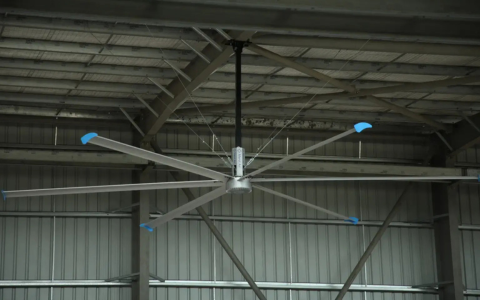
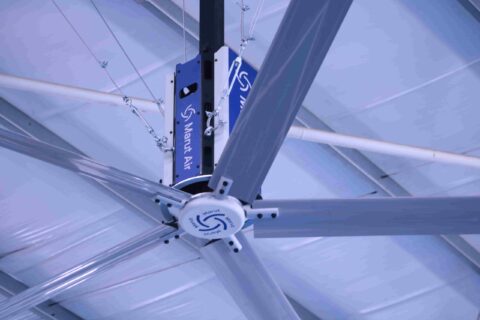
For example, using energy-efficient High Volume Low Speed (HVLS) Fans can produce a larger volume of moving air with lower wattage than traditional fans. When the use of Natural Ventilation is combined with The Benefits of HVLS Fans, the end result can be lower energy use, improved comfort and reduced reliance on A/C.
Investing in energy-efficient systems typically provides more cost savings over the long term than initial installation costs.
Plan Ventilation Depending on Equipment Layout
Ventilation must not be thought of as a finishing touch. The layout of your machines, storage racks, and production lines has a direct impact on airflow.
When you are planning expansion:
- Be careful not to hinder the airflow.
- It is paramount that enough space is left around heat-producing pieces of equipment.
- Make sure that the fans are properly installed.
- The height of the ceiling must also be taken into consideration.
The coordinated layout will help to keep the equipment cool preventing hot air spots.
Plan Dust and Airborne Particles Impact
A lot of industries create dust smoke and tiny particles which can be bad for the employees as well as the machinery.
In your ventilation planning you need to think of the following:
- Dust removal systems
- Proper exhaust positions
- Air inlet points
- Regular air purification
Proper control means both the production of higher quality goods and less frequent maintenance.
Future Growth is an Important Point
Many manufacturing plants grow again several years later. Do not design the ventilation system only for the current stage make sure to think of possible further installations.
A scalable ventilation system allows for adding necessary machines later on without changing the whole system.
With the help of good planning possible renovation costs in the future can be reduced significantly.
Employees’ Comfort is Significant
Employees are working for long hours at the production stations. High temperatures and bad air can cause tiredness lack of attention and loss of productivity.
- Better employee retention
- Decreased risk of accidents in the workplace
- Good ventilation works as both a win-win for your people and your company.
Compliance with Safety Regulations Should Be Ensured
Factory expansions could require a renewed safety approval depending on the local legislation.
Your ventilation solution should support compliance with various environmental, health, and fire safety regulations. Compliance with those regulations during the organizational stage will help you avoid penalties, risks, or expensive redesign in the future.
Conduct Regular Ventilation Cleaning
No matter the quality of your ventilation system cleaning and repair procedures should always be implemented.
You should devise a cleaning plan that must include:
- Cleaning vents and fans.
- Carrying out inspections on the motors.
- Conducting a check of filters.
- Observing airflow performance.
- Monitoring energy consumption.
Regular maintenance of the ventilation equipment will improve its performance.
Blockquote
“Smart ventilation planning today prevents costly problems tomorrow.”
Conclusion
Factory expansions are not just about expanding space or producing more. A good factory expansion means creating a comfortable, efficient, and safe workspace and a truly low-cost, long-term operation.
Ventilation must be included in the expansion plans from day one in order to avoid high retrofitted costs.
Ventilation should not be considered as an additional expense but rather as an investment that guarantees sustainable operation and growth of your factory for a long time.
Maruit Air is a top company that has helped in the factory expansion for many companies by providing the best ventilation fans. The company provides the best HVLS fans and other products. Feel free to learn more about the products and services.
Contact details
Company name – Maruit Air
Address – 1st and 2nd Floor, Marut Corporate House, Behind the capital, Science City Road, Sola, Ahmedabad, Gujarat, India 380060
Contact – +91 63526 03898
E-mail – ops6@marutair.com
Frequently Asked Questions
Why is it important to consider ventilation during factory expansion?
Ventilation is important because it improves air quality, the comfort of workers, and is energy efficient.
Can proper ventilation help to reduce operating costs?
Definitely, as proper ventilation leads to lower cost of energy, maintenance and equipment downtime.
When should one plan a factory’s ventilation?
The factory’s ventilation should be planned before starting construction/expansion.
How does poor factory ventilation affect employees?
Poor ventilation makes employees suffer from heat stress, fatigue and poor performance.
Is it possible to upgrade ventilation systems in the future?
Yes, given that all ventilation systems are scalable and easy to adjust for future expansion of your factory.
How frequently should ventilation system inspections be conducted?
Regular inspections and maintenance of ventilation systems are necessary to ensure their effectiveness.