
Comfort and productivity today depend on the airflow that is maintained within today’s industrial and commercial environments. In the case of large places, conventional fans have their limited sizes, fritzing in building that much efficiency. This is where HVLS or High Volume Low-Speed fans by Marut Air come into play to change the game.
What are the Key Differences Between HVLS Fans & Small Fans?
| Feature | HVLS Fans | Small Fans |
| Size | Very large, with blade diameters up to 24 feet | Small, typically 12 to 18 inches |
| Airflow | Moves a large volume of air slowly and efficiently across a wide area | Moves a smaller volume of air at a high speed for localized cooling |
| Speed (RPM) | Low, typically 50–125 RPM | High |
| Application | Ideal for warehouses, factories, gyms, and large retail spaces | Suitable for homes, individual rooms, and small offices |
| Energy Efficiency | Highly energy-efficient for large spaces due to low-speed operation | Less efficient for large areas compared to a single HVLS fan |
| Coverage | Provides uniform airflow across large open areas | Limited coverage, cools only a small area |
| Noise | Quieter despite its large size | Can be noisy because of high-speed operation |
3 Reasons Why HVLS Fans Are Better Than Small Ones
Effective Air Distribution
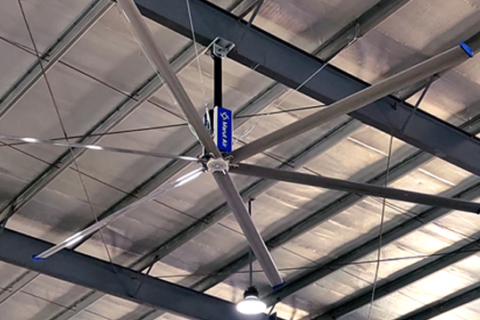
HVLS fans are designed to circulate large volumes of air at slow speeds and, therefore, work well in large spaces: warehouses, gyms, factories, and retail areas. Unlike small fans that are locally used, the fans evenly distribute air across a wider room for the comfort of everyone inside. This necessarily makes them far more effective in managing temperature and humidity.
Energy Efficiency
Among the biggest advantages of HVLS is their energy efficiency. Since they are big and run at low speed, HVLS fans use much less power to operate than a combination of many small fans running simultaneously. This way, by saving energy, a business reduces the cost of operating its activities and thereby makes HVLS fans a very environment-friendly alternative. Looking at the rise in energy prices and sustainability issues, the installation of HVLS fans from Marut Air will be a smart, long-term decision.
Lower Cost of Maintenance
Needless to say, HVLS fans are built to last. Having fewer moving parts in their makeup and a more robust design than their brethren, maintenance for these fans is very limited. This, in turn, will equate to lesser downtime and, eventually, lower maintenance costs for any business. Thus, this makes them a very practical and cost-effective solution in the long term.
What are the Key Benefits of Choosing HVLS Fans for Commercial & Industrial Spaces?
Some of the key benefits of choosing HVLS Fans for commercial & industrial spaces:
- Energy efficiency: They displace large quantities of air at low speeds, utilizing little electricity, to bring dramatic reductions to energy bills compared to conventional cooling systems.
- Improved air circulation and quality: They eliminate hot/cold spots, prevent stagnant air, aid in diluting airborne contaminants, and therefore produce an overall improved environment.
- Increased productivity: Comfortably warm employees are more productive. They assist in temperature regulation, and ultimately heat stress and absenteeism.
- Year-round comfort: In the winter the reversible motor can be used to destratify warm air and push it down from the ceiling to lessen heating costs.
- Reduced humidity: They help to reduce humidity levels, protecting equipment and inventory from moisture damage.
Conclusion
Large halls can effectively improve air circulation with the help of Marut Air HVLS fans, which come with efficiency, energy savings, and long-term advantages. Unlike small fans, HVLS fans ensure better comfort with uniform airflow dissemination at lower operational costs. Fulfill your next cooling requirement with Marut Air and experience the difference in quality, efficiency, and reliability of these fans.
FAQs About HVLS Fans & Small Fans
Question 1. What is it about HVLS fans that makes them more efficient than small fans?
Answer. HVLS fans can move a higher volume of air at a slower speed and also provide cooling air throughout larger areas. Small fans provide localized cooling to a single area.
Question 2. Can HVLS fans lower your electric bill in an industrial application?
Answer. Yes, because HVLS fans use fewer fans and less energy, there is typically a significant decrease in the electric bill.
Question 3. Do HVLS fans require more maintenance than small fans?
Answer. No, HVLS fans are built to run longer with less maintenance than small fans that need significantly more servicing.
Question 4. Which industries benefit the most from HVLS fans?
Answer. HVLS fans benefit warehouses, factories, gyms, dairy farms, supermarkets, and other large commercial applications the most.