
Trusted by Industry Leaders


Application of HVLS Fans
Accurate solution proposition. Both Small Size HVLS fans and Jumbo Ceiling Fan Manufactured by us are ideal for commercial and industrial spaced such as warehouses, factories, food courts, schools, indoor stadiums and gymnasiums.
Marut Air HVLS Fans are a wise purchase for any company or industry that wants to maintain comfortable Interior temperature and Fresh Air Quality. Our High Volume Low Speed Fan comes with the advantage of high energy efficiency and high volume air circulation.


How do HVLS fans work?
HVLS fans operate on the premise that cool flowing air separates the boundary layer surrounding the body that is saturated with moisture and speeds up evaporation to generate a cooling effect. As they rotate, ceiling fans create a column of air. Along the floor, this air column flows downward and outward. This thick wall of horizontally flowing air, also known as a horizontal floor jet, is related to a fan’s diameter and, to a lesser extent, its speed. The floor jet moves outward until it encounters a side wall or other vertical surface after it reaches its maximum capacity.
Industrial Jumbo ceiling fan, or another name commonly known as HVLS (High Volume Low Speed), causes high volume of wind movement and low ground. Before colliding with the ground and changing direction to become a ‘floor jet’, moving around 360 degrees in all directions, also helping to push dust from the nook or corner out of the area.
What Makes Us The Top
HVLS Fan Supplier in India
Marut Air HVLS fans are proving why they belong at the forefront of HVLS fan manufacturers in India.
– Exceptional Quality at a Reasonable Price.
– All models have CE certification and a good service network.
– One of the company’s key businesses is the HVLS Fan, which has specialised support that is available forever.
– Every component is made with the same high standards of quality as foreign fans.
– A quality product and timely after-sales support are guaranteed by management’s direct involvement in day-to-day manufacturing and after-sales activities.
HVLS fan – MRT- 7
HVLS fan – MRT- 6
HVLS fan – MRT- 5
HVLS fan – MRT- 4
HVLS fan – MRT- 3.7
HVLS fan – MRT- 3
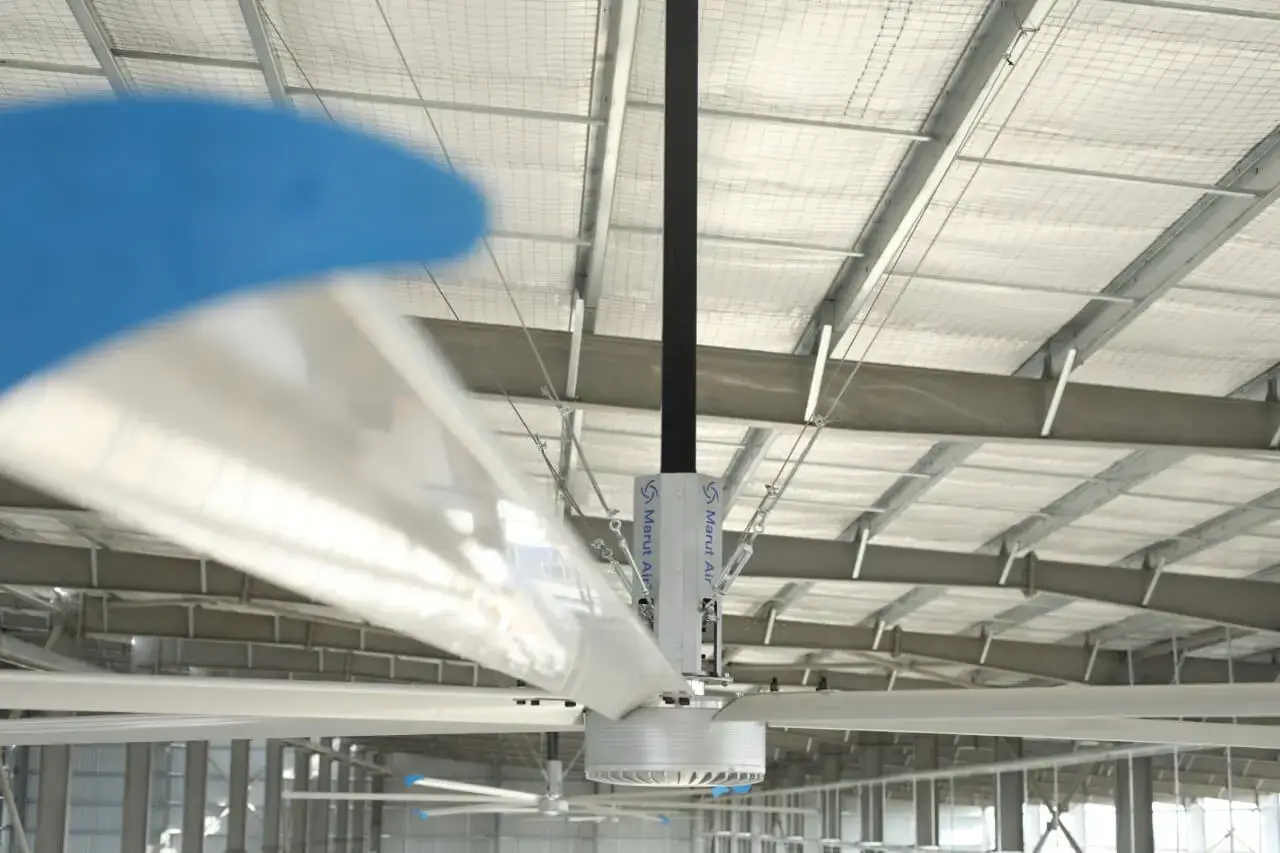
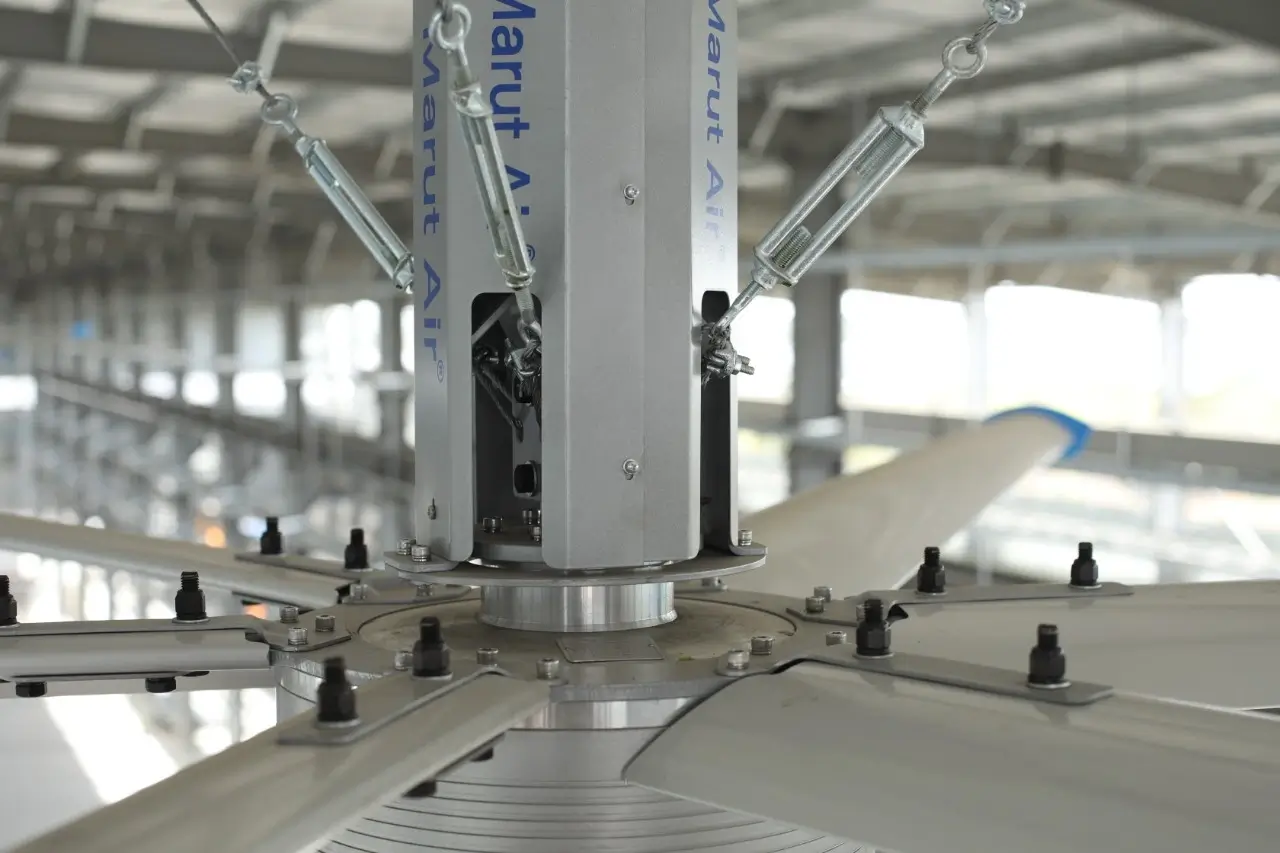
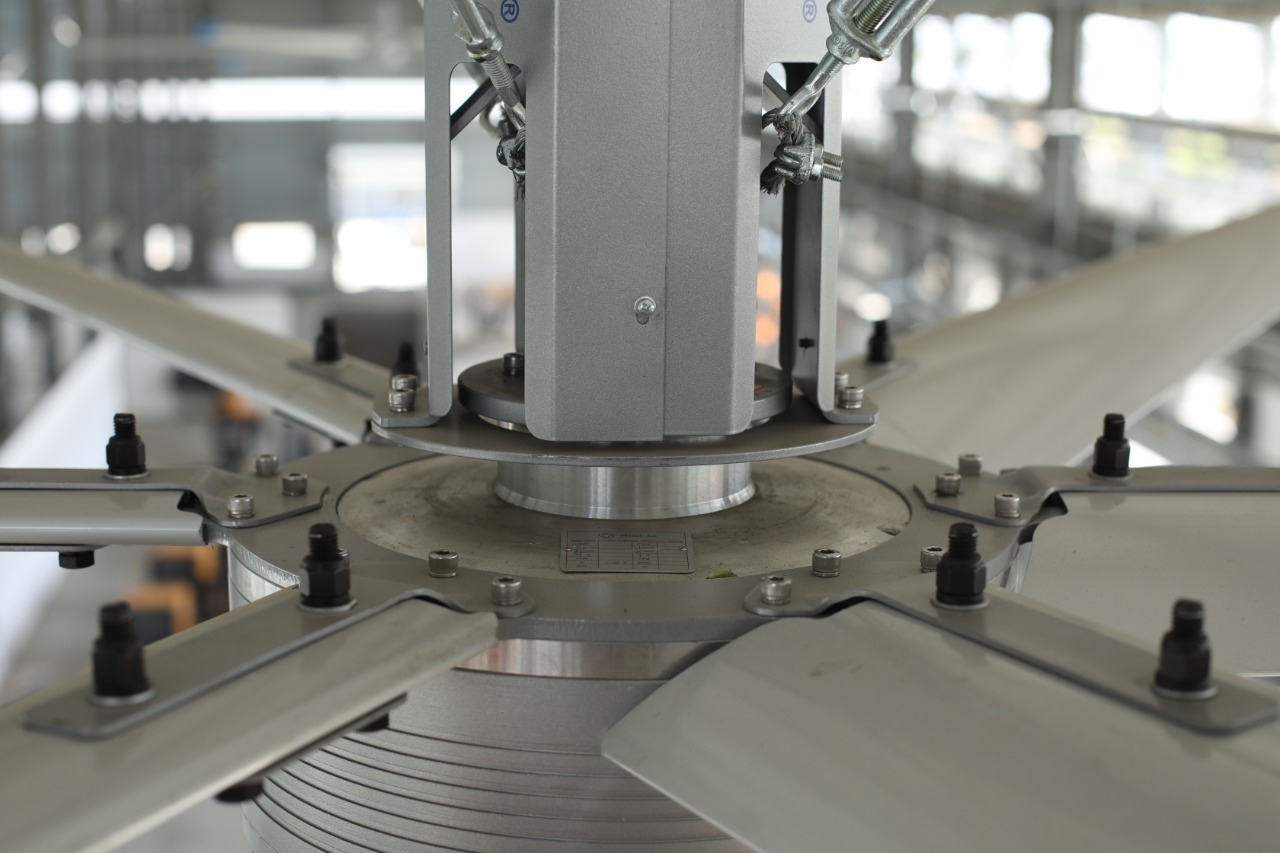
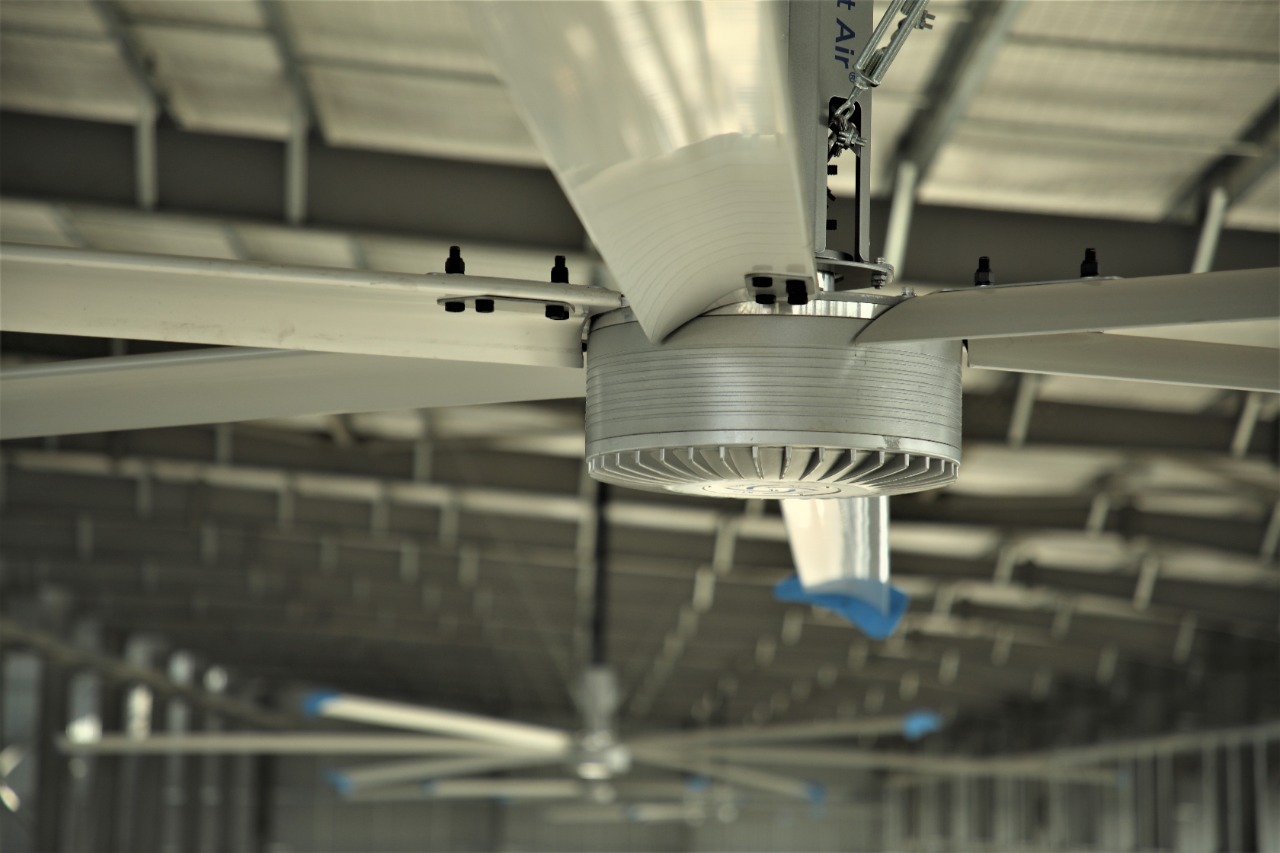
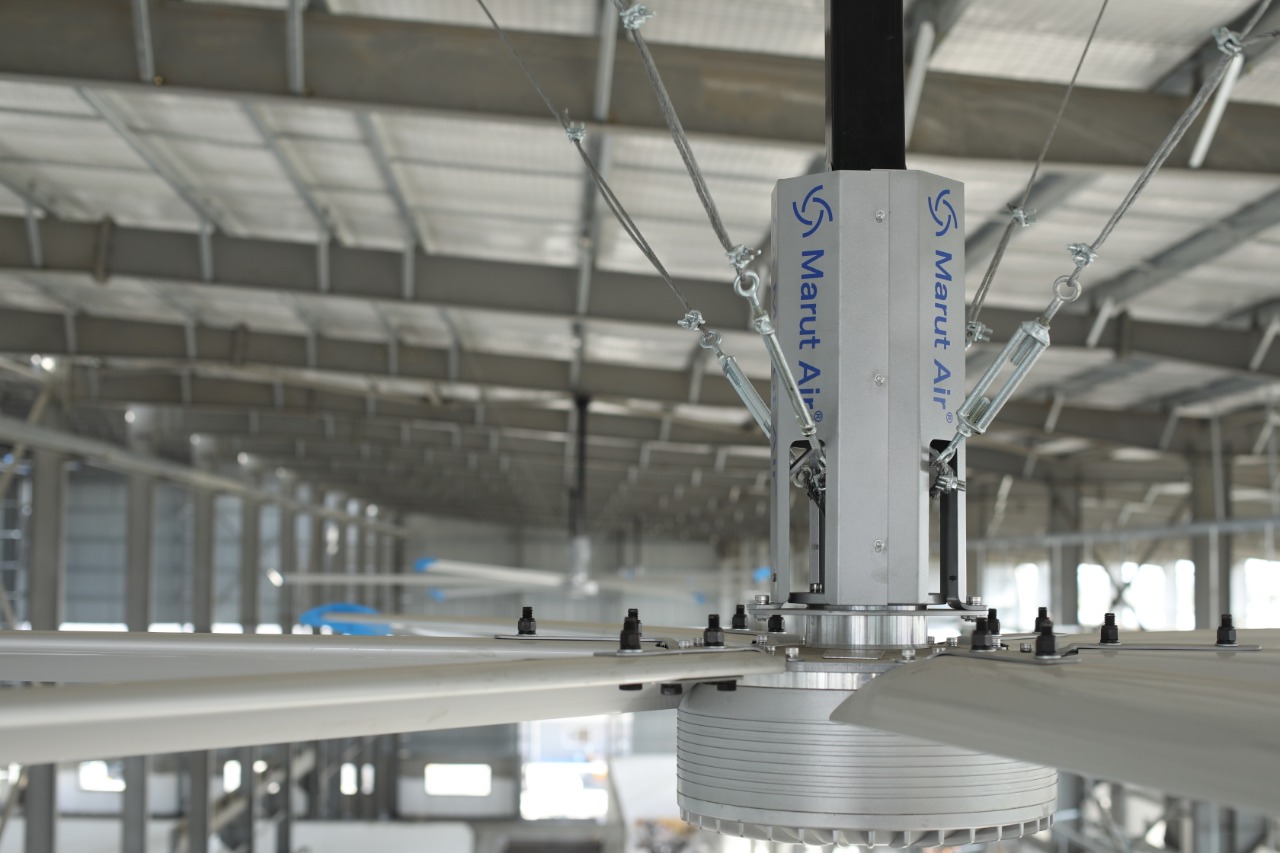
Mounting & Details

Advantages Of HVLS Fan
 Gear Box Fan | Marut Air PMSM Tech |
|---|---|
| Power consumption is huge | Saves hug cost by power saving |
| Gear Reducer Type Motor | Direct Drive Servo Motor |
| High Power Consumption, Less Output | Highest Efficiency,Less Power Consumption |
| Periodic Maintenance required for oil seal, gear box oil | No Maintenance due to simple design |
| Made with Gear Reducer Type. | Made with rare earth Neodymium magnets. It has 20X better life than normal magnets. |
Technical Configuration for Marut Air HVLS Fans
| Model | Size (Dia) | Motor kW/HP | RPM | Air Volume(CMM) | Total Weight (Kg) | Coverage (SQ.M) | Frequency(Hz) | dBA* |
|---|---|---|---|---|---|---|---|---|
| MRT-7a | 7.3m(24ft) | 1.1/1.5 | 0-55 | 13,000 | 111 | 1500 | 50/60 | 38 |
| MRT-6a | 6.1m(20ft) | 1.1/1.5 | 0-60 | 11,500 | 103 | 1000 | 50/60 | 38 |
| MRT-5a | 5.5m(18ft) | 1.1/1.5 | 0-70 | 11,000 | 99 | 900 | 50/60 | 55 |
| MRT-4a | 4.9m(16ft) | 1.1/1.5 | 0-70 | 10,000 | 49 | 600 | 50/60 | 55 |
| MRT-3.7a | 3.7m(12ft) | 0.37/0.5 | 0-85 | 5,000 | 38 | 380 | 50/60 | 55 |
| MRT-3a | 3.0m(10ft) | 0.37/0.5 | 0-115 | 4,000 | 35 | 250 | 50/60 | 55 |
Our Certifications


Best HVLS Fans Manufacturer in India
Professional Installation
Following the complete checklist

Frequently Asked Questions
- What is an HVLS fan?
A High-Volume Low-Speed Fan, better known as an HVLS fan, is a large ceiling fan with a diameter of at least 7 feet (2.13 m). HVLS fans move slowly and distribute large amounts of air at low rotational speed, hence the name “high volume, low speed.”
- Are HVLS fans only for industries?
No, HVLS fans can be used in any large space to maintain adequate temperature. HVLS Fans are used in a variety of settings, including Party Halls, Conference Halls, Commercial Centres, Sports Centres, Residential Spaces, and Industrial settings.
- What is the use of HVLS fans?
HVLS fans have a number of benefits, including improved air circulation, reduced energy consumption, reduced noise pollution, and Improved air quality.
- Where to buy HVLS ceiling fans?
Marut Air is a leading manufacturer of HVLS ceiling fans in India. We have a wide variety of models of HVLS fans to choose from, and We offer a free quote on all of our products, including HVLS Fans, Exhaust Fans, Industrial Air Coolers, and more. You can contact us by phone or email, or you can visit our website to get a quote.
- What makes HVLS fans more energy efficient in comparison to AC?
HVLS fans are efficient because they move large amounts of air at low rotational speeds, thus they require less energy than traditional air conditioning systems to cool a space.
- How much energy does an HVLS fan use?
The amount of energy that an HVLS fan uses depends on a number of factors, including the size of the fan, the speed of the fan, and the climate. However, HVLS fans typically consume far less energy than traditional air conditioning systems.
- How much area does an HVLS fan cover?
The amount of area that an HVLS fan covers depends on the size of the fan. A typical HVLS fan with a diameter of 12 feet (3.66 m) can cover an area of up to 15,000 square feet (ca. 1,394 m²).
- What is the minimum height requirement for HVLS fans?
The minimum height for HVLS fans is typically 12 feet (3.66 m). However, the exact height requirement may vary depending on the specific fan and the space where it is being installed.
- What is the maximum speed of HVLS fans?
The maximum speed of HVLS fans typically ranges from 55 to 130 RPM. However, the exact speed may vary depending on the specific fan and the setting in which it is being used.
- How to choose an HVLS fan?
Here are some factors to consider when selecting an HVLS fan:
- The size of the space you need to cool,
- Ceiling height,
- Climate.
- Noise level and
- Budget.
- How is HVLS fan size calculated?
The size of an HVLS fan is calculated by the diameter of the fan. The most common sizes are 12 feet, 16 feet, and 24 feet. The larger the fan, the more air it will move and the cooler your space will be.
- What is the lifespan of a HVLS fan?
The life span of an HVLS fan can vary depending on the quality of the fan and the conditions it is used in. In general, HVLS fans can last for many years with proper maintenance.
- How much does the HVLS fan cost?
The cost will depend on the size of the fan, the features it comes with, and the brand.
- What is the warranty period of an HVLS fan?
The warranty on an HVLS fan will vary depending on the manufacturer. Some manufacturers offer a one-year warranty, while Marut Air offers a five-year warranty or even a lifetime warranty on some parts.
- Is it expensive to repair an HVLS fan if something goes wrong?
Repairing an HVLS fan can be expensive, but it is usually less expensive than replacing the fan altogether. The cost of repair will depend on the problem with the fan and the cost of parts.
- Can the speed of the HVLS fan be manually adjusted?
Yes, the speed of an HVLS fan can be adjusted. This allows you to control the amount of air that is circulated and the amount of cooling that is provided.
- Can HVLS fans be mounted outdoors?
Yes, HVLS fans can be mounted outdoors. However, they need to be protected from the elements. Some HVLS fans are specifically designed for outdoor use and come with weatherproof housings.
- What types of facilities benefit from HVLS fans?
HVLS fans can benefit from a variety of facilities, including:
- Warehouses
- Distribution centers
- Gyms
- Factories
- Schools
- Hospitals
- Churches
- Other large, open spaces.

