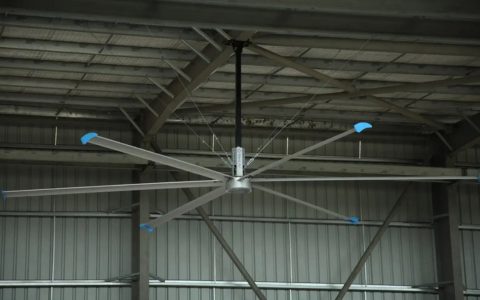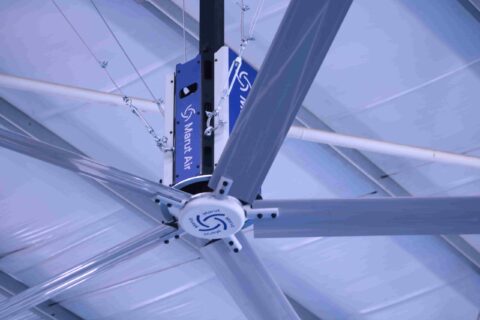

How to Calculate the CFM Required for an Industrial Exhaust Fan – Good ventilation is key to creating a safe and efficient working environment. Factories, warehouses, manufacturing sites, and offices can often suffer from poor air quality due to heat, dust, fumes, and humidity. Installing an Industrial Exhaust Fan allows the poor air to be extracted, and good airflow can be achieved. Alongside determining the size and power of the fan, there are further factors that must be assessed to correctly identify an Industrial Fan.
How to Calculate Required CFM? Multiply the volume of a room (calculated by length x width x height) by the number of air changes (in hours), and then divide it by 60 to establish the required CFM.
By understanding how to calculate CFM, companies can decide which Industrial Fan is suitable for their premises and enhance their ventilation. Furthermore, this process will assist in optimising energy usage.
What Does CFM Mean?

Cubic Feet Per Minute (CFM) reflects an Exhaust Fan’s ability to move air.
An exhaust fan with a 10,000 CFM rating is able to ideally displace 10,000 cubic feet of air per minute (depending on ideal testing conditions).
CFM is a significant factor in identifying an optimal Industrial Fan, as it reflects a fan’s air displacement capability.
Whilst typically, the greater the CFM value, the higher the air displacement, a fan’s performance will also be affected by factors such as system and ductwork resistance, filters, louvers, and static pressure.
Establish Room Volume
Identify the volume of the area for which you wish to provide ventilation.
Room Volume = Length x Width x Height.
Ensure that all dimensions are given in feet so that the volume can be established in cubic feet.
For example:
- Length – 100ft
- Width – 60ft
- Height – 20ft
Volume = 100 x 60 x 20 = 120,000 cubic feet.
There is thus around 120,000 cubic feet of air within this industrial warehouse.
Having identified your room volume, you can then identify a fan’s required CFM.
Establish Required Air Changes Per Hour (ACH)
Air Changes Per Hour shows how many times in an hour the air within a room can ideally be renewed.
Depending on the type of industry and related factors (such as heat, number of people, and desired air quality), differing numbers of air changes may be necessary.
Typically:
- Warehouses require ventilation dependent upon heat and number of people within them.
- Manufacturing sites may need increased ventilation depending on what is being manufactured.
- Food industries may need to regulate both humidity and air quality.
- Workshops might additionally need ventilation to extract fumes and particulates.
Rather than arbitrarily deciding upon an ACH figure, research relevant ventilation guidelines and consult an HVAC specialist to ascertain the most suitable ACH for your premises.
Apply the CFM Equation
With knowledge of both room volume and desired ACH, enter these values into the following equation to identify required CFM:
CFM = (Volume x ACH) / 60.
Below is a worked example:
- Volume – 120,000 cubic feet
- ACH – 6
Calculation:
- CFM = (120,000 x 6) / 60
- CFM = 720,000 / 60
- CFM = 12,000
Ideally, this warehouse would therefore require an exhaust fan with a 12,000CFM air displacement capability to provide 6 air changes per hour.
Please note that this is only a basic ventilation calculation. Realistic fan requirements can be influenced by a variety of factors such as heat, air pollution, and ventilation configuration.
Assess Static Pressure
Many people incorrectly prioritise the CFM specification of an Industrial Fan.
During operation, fans can experience reduced air displacement due to resistance caused by:
- Ducts and corners
- Filters and louvers
- Safety guards
- Air intake
- Exhaust discharge
Such resistance is referred to as static pressure.
Prior to fan purchase, examine the fan’s performance graph so that you can confirm that it can successfully supply air at the correct CFM level despite the system’s static pressure. This will ensure that an Industrial Fan is able to effectively ventilate post-installation.
Evaluate Number of Fans Required
Divide the total required CFM by the individual fan’s CFM to ascertain the number of fans that will be required.
Use this formula:
Number of Fans = Total Required CFM ÷ CFM per Fan
For instance:
- Total required CFM – 12,000
- CFM per fan – 4,000
12,000 / 4,000 = 3
Ideally, three fans would thus be required. Again, this could vary depending on fan performance, installation, and ventilation configuration.
Alongside identifying the right fans for your site, consideration should also be given to where they are installed and to ensuring that enough fresh air intakes are present.
Factor in Heat, Humidity and Industry Type
Sometimes, merely analysing air changes will not fully meet ventilation needs.
Where premises produce considerable heat, fumes, dust and/or humidity, specific ventilation calculations may be necessary.
For example, manufacturing premises containing high-temperature equipment may need to base their exhaust air displacement on heat output. Likewise, premises working with dangerous materials may need to implement bespoke local exhaust ventilation rather than depend solely on overall air changes.
Correctly chosen Industrial Exhaust Fans should relate to real ventilation needs as well as property size.
Conclusion
It is vital to assess the required CFM value to identify suitable Industrial Exhaust Fans. Correctly evaluating air displacement facilitates enhanced ventilation, thermal regulation, and promotes good health within workplaces.
If you are seeking quality Individual Fans and Exhaust Fans, then look to Marut Air who can provide industrial ventilation for factories, warehouses and offices.
View Marut Air’s range of Industrial Exhaust Fans and FRP Exhaust Fans. Contact the Marut Air team to identify the most appropriate ventilation option for your business.
FAQs
How do I calculate CFM for an industrial exhaust fan?
CFM can be calculated by dividing the product of room volume (in cubic feet) and air changes per hour by 60. That is: CFM = (Volume x Air Changes Per Hour)/60.
How much CFM should my industrial exhaust fan have?
Factors including property size and height, together with ventilation needs and sources of heat and industry type, all influence the required CFM. Usually, larger properties will possess greater ventilation needs. Nevertheless, detailed ventilation analysis should be completed to ascertain precise fan requirements.
What does ACH mean in relation to industrial ventilation?
Air Changes Per Hour is the figure that demonstrates how many times, per hour, the air volume of a room is ideally renewed. It is frequently utilised to approximately establish ventilation needs.
Will a fan with a larger CFM always perform more effectively?
Whilst a higher CFM suggests that more air can be displaced, fan effectiveness is also impacted by static pressure and fan efficiency. Installation and air dispersion will also affect performance. More crucially, it is important to identify the most fitting fan for a particular use, rather than purely seek out the fan with the largest CFM.
How do I pick an appropriate industrial exhaust fan?
Factors to analyse include room volume, ACH, heat and air pollution, fan CFM, static pressure, energy use, installation position and servicing needs. To precisely identify the most suitable fan, it is advisable to consult an industrial ventilation specialist.