
Circular inline fans are compact ventilation devices that can move air within circular duct systems. Generally placed somewhere within the ventilation system rather than at the exhaust outlet like an exhaust fan, the cylindrical structure of circular inline fans means that they are designed to fit within standard circular ducting while still being efficient.
Due to the fact that they can increase airflow and ventilation, yet they are inconspicuous when it is installed in visible locations. The fans were commonly utilized in commercial, residential, as well as industrial locations where the followers were adaptable, supplied smooth airflow and did not produce a considerable quantity of noise.
In this blog, we will talk about What Are Circular Inline Fans and Where Are They Best Used.
How Do Circular Inline Fans Operate?
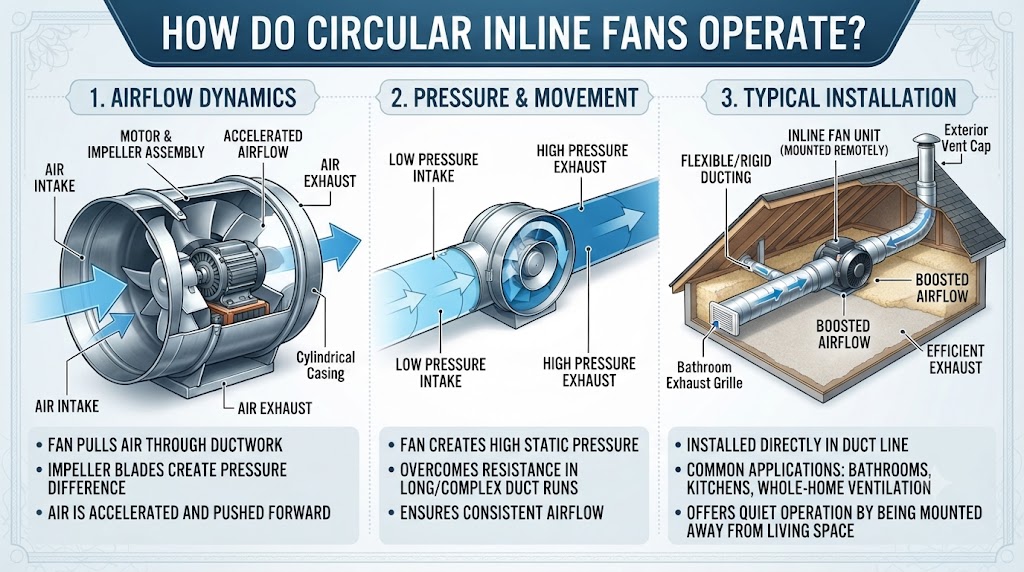
The circular inline fan includes a motor and fan with blades situated within a round, tubular-shaped casing. As the fan motor spins, air is pulled into one end of the cylindrical-shaped casing and forced out the opposite end.
A circular inline fan is plumbed directly into a circular duct line to transmit air throughout a room, between areas or even to the exterior.
Circular inline fans can also be constructed to both deliver fresh air and pull away exhaust air as they assist with circulating the air in an area continually. Because circular inline fans attach to the actual ductwork, they can also be beneficial in systems where a ventilation source may have to be disconnected from the fan.
The Main Advantages of Circular Inline Fans
1. Space Saving
A key reason to consider circular inline fans is their compact, space-saving design. The cylindrical form factor of the fan housing fits conveniently into a circular duct system.
This allows a fan to be placed into a duct system, where wall or ceiling space for installation might be limited.
2. Proper movement of the air
The fans are designed to operate as efficient air-moving devices within ducting systems. They are capable of removing stale air, excess moisture, heat, odors, and harmful contaminants, depending on how the inline fan is implemented.
3. Flexible Mounting
Circular inline fans can be placed in various locations in a ventilation system. This flexibility enables their design for the different locations of rooms in a building with a peculiar structure.
4. It Is Perfect for Continuous Ventilation
A great number of inline circular fans are geared towards frequent and continuous work, the moment one picks and mounts it properly. The fan can sustain prolonged air circulation and indoor atmospheric conditions to promote good IAQ.
When are Circular Inline Fans Most Useful?
These are suitable for most applications. These are the most beneficial for environments that require ductwork.
Bathrooms and Toilets
Humid air is produced in bathrooms and toilets; inadequate airflow can lead to steam build-up, a strong odor and even mildew and mould. A circular inline fan can extract the humid air by ventilating it out through the building via the ductwork.
Kitchens
A significant by-product of cooking is heat as well as the production of steam, smoke, and odors, where an inline fan is able to vent these away from the room, and would typically be used when a conventional, wall-mounted exhaust fan is impractical.
Offices and Commercial buildings
Air exchange is as important in an office environment for maintaining an acceptable internal atmosphere. Circular inline fans can also be incorporated into much larger ducting systems in order to ensure a greater air exchange rate within a certain room or part of a commercial building.
Warehouses & Workshops
Workplaces need proper ventilation of the hot air to maintain the temperature in the area. Inline circular fans are very effective in providing the best air ventilation by taking out the hot air and replacing it with fresh air.
Grown rooms / Controlled environments
A number of different factors influencing growth such as temp/humidity and air movement must often be controlled in an indoor environment and for such applications our circular inline fan can be used with appropriate ducting and control equipment.
Residential areas
Inline ventilation can be applied to homes particularly within bathrooms, utility rooms, laundries, basements, and any room of the house which areprone to accumulating moist or stale air.
Important Factors to Know Before You Select a Circular Inline Fan
Selecting a fan is not so simple. You cannot choose an inline circular fan simply on the duct size. You have to measure the airflow requirement according to your space area and functionality.
Here, we enlisted the factors that one has to keep in mind before purchase:
- Airflow capacity: Check the m/h or CFM requirement of the space.
- Duct size: The size of the fan must match the size of the duct used for ventilation.
- Static pressure: This increases with the use of long ducts, bends, grilles, filters etc.
- Noise level: Consider low-noise models if you plan to install them in bedrooms, offices or any living area.
- Motor efficiency: Efficient motors save energy, thus cutting electricity bills.
- Operating environment: Think about whether temperature, humidity, and dust will also be present at the location of installation.
- Controls: Timers, controllers, or automated systems are available which might prove to be handy as needed.
Circular Inline Fans vs Conventional Exhaust Fans
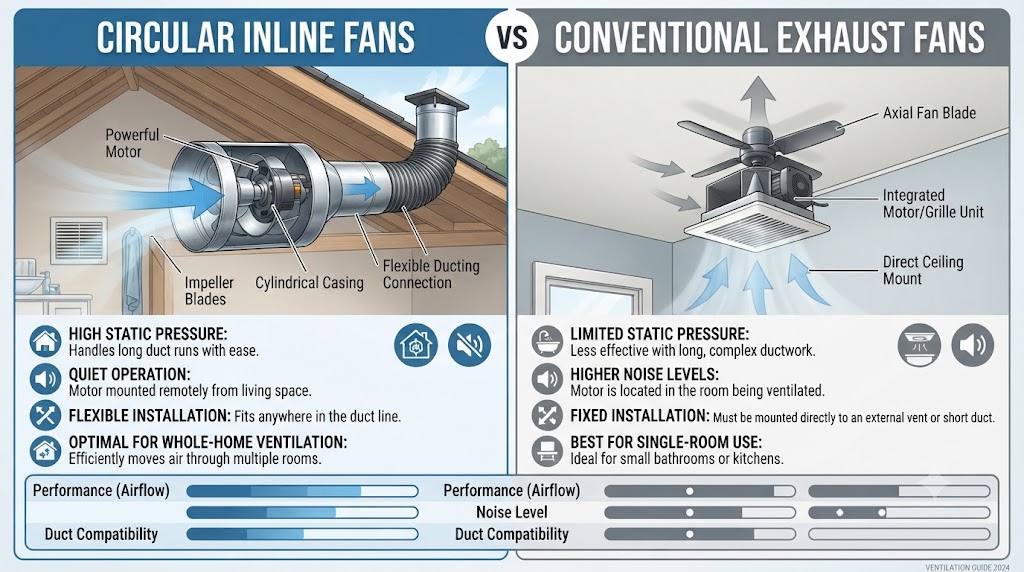
The major distinction is the position of installation. An exhaust fan is often situated on a wall or ceiling or in a hole to the outside, whereas an inline fan is integrated within the ductwork.
This can make the inline fan ideal for when there is a large distance from the exhaust point and the room, or a multiple array of fixtures that need to be linked in by a duct system. Concealed installations are made much more achievable by this particular system.
The ultimate selection to be made will rely heavily on the rate of airflow required, the layout of the ducting, the resistance to pressure, size limitations, and the environment within which the fan will operate.
In Conclusion
Circular Inline Fans are handy for moving air through circular ductwork systems. Due to their compact, easy installation and ability to allow constant ventilation they make great fans for home, office, commercial use, workshops, sheds, warehouses, kitchens and bathrooms or controlled environments.
Maruit Air is a top provider of Circular Inline Fans and offers them at the most reasonable prices. The quality is world-class and is highly durable. Feel free to get yourself the best circular inline fan customized to your needs and preferences.
Contact details
Company name – Maruit Air
Address – 1st and 2nd Floor, Marut Corporate House, Behind the Capital, Science City Road, Sola, Ahmedabad, Gujarat, India 380060
Contact – +91 63526 03898
E-mail – ops6@marutair.com
Website – https://marutair.com/
Frequently Asked Questions
- Do circular inline fans work in a small room?
Yes, they can be used in small rooms such as bathrooms, kitchens, utility rooms, storage areas, and other places that require effective removal of air.
- Can circular inline fans be used as intake?
Yes, inline fans can be used to extract air out of a room or supply fresh air into a room depending on the system design.
- Do circular inline fans require ducting?
Yes, circular inline fans are used as part of a ducted ventilation system and installed within circular ductwork.
- Can an inline fan help the quality of air in a room?
Yes, ventilation helps remove stale air, excess humidity, smells, heat and other pollutants from a room.
- How long can a circular inline fan run continuously?
A suitably rated fan can be designed for constant running, but you must consult the product manual before allowing any inline fan to run constantly.
- Can circular inline fans be used in industry?
Yes, some powerful models are suitable for use in workshops, storage rooms, commercial offices and a variety of other industrial spaces where air extraction is necessary.