
For maintaining airflow, temperature control and air quality in factories and warehouses, industrial fans play a crucial role. But improper cleaning of industrial fans can affect their performance by disrupting fan balance, straining motors and reducing overall efficiency. In this blog, Marut Air will provide you with everything you need to know about How to Clean Industrial Fans Without Affecting Performance with the safest and most effective cleaning practices.
Why Proper Cleaning of Industrial Fans Matters?
For maintaining high levels of productivity with industrial fan systems, maintenance is crucial for economical, reliable operation. A proper cleaning program will maintain fan efficiencies while avoiding 20% to 30% loss of effectiveness and reducing the risk of overheating and wasting electrical power.
- Preventing Breakdown: By cleaning the fan, dust, grease and debris accumulations can be removed that lead to unbalanced rotor assembly & increasing unwanted vibration.
- Safety Concerns: Keeping the fan clean lowers the potential for fires and provides a means for proper removal of fumes.
- Energy Efficient Operation: A well maintained fan operates at optimal efficiency resulting in less electricity usage.
- Life Extension: By properly cleaning and maintaining the motor and bearings life of the fan and its associated components will increase by 5 to 10 years.
What are the Types of Industrial Fans and Their Cleaning Requirements?
Exhaust Fans for Industrial Use:
Must be maintained regularly, including cleaning the fan blades and housing with an approved degreasing solution while ensuring that the fan motors remain free from moisture.
Maintenance of HVLS Fans:
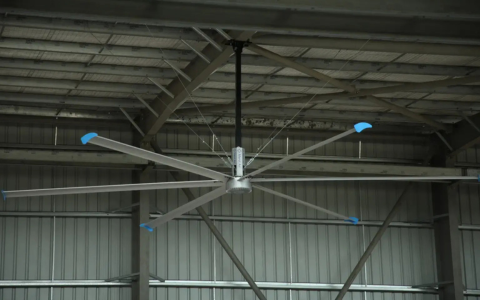
Due to their large size and low-speed operation, HVLS fans are highly sensitive to any form of imbalance. So cleaning HVLS Fan blades should be performed uniformly and using soft cleaning equipment.
Commonly used in ventilation systems, these fans will require periodic cleaning of the blades, guards and casings to prevent blockages in the airflow system.
Centrifugal Fans:
Commonly used in the higher pressure applications, they require special attention when cleaning the impeller and interior housing to prevent the potential for vibration related failure and imbalance.
Subjected to outdoor dust and moisture, wall mounted and roof-mounted fans require regular inspection and cleaning of their external surfaces and must also be checked for corrosion.

Common Mistakes That Affect Fan Performance During Cleaning
Mistakes made while cleaning ceiling fans that will hinder performance:
- Blades Being Bent – Cleaning a ceiling fan by putting excessive amounts of pressure on the blades will bend and warp the blades. This alters the aerodynamics of the blades and leads to uneven airflow.
- Residual Moisture Left – Not drying the ceiling fan completely after wet-wiping it will create rust, corrosion, and damage to wood blades. This decreases the ceiling fan’s life.
- Failure to Clean Motor Housing – Dust accumulation on the motor housing can impede heat dissipation from the motor, which can lead to an overheating motor and sluggish ceiling fan performance.
- Harsh Cleaners Used – Ammonia and abrasive cleaners, when used on the ceiling fan, destroy the protective coating and allow future dirt to adhere.
- Not Cleaning Both Sides of the Blades – Cleaning only the underside of the blades does not address the buildup on the top side.
- Loose Screws Not Tightened – Once the ceiling fan is cleaned, and the screws should be retightened to remove the wobbling of the fan. Wobbling creates friction and noise.
Step-by-Step Guide: How to Clean Industrial Fans Safely
By cleaning your industrial fans properly, you can help maintain airflow and efficiency while prolonging the life of your equipment with no possibility of damage.
Step 1: To do this, you’ll want to disconnect power from the fan, lockout/tagout using standard procedures so everyone in the area is safe.
Step 2: Next, you will want to inspect the blades, housing, fasteners and guards for buildup of dust, damage or loose parts.
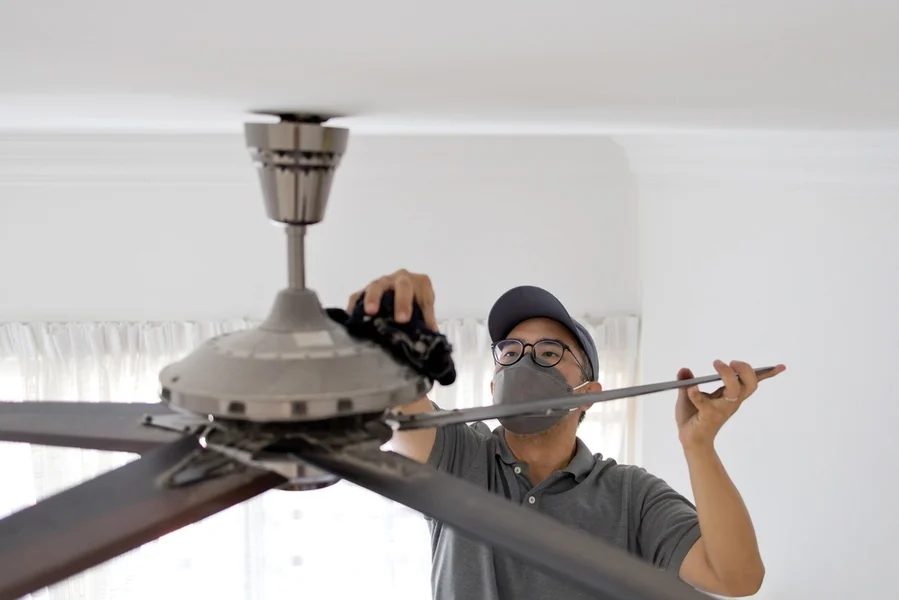
Step 3: Once completed, dry cleaning should occur before you begin wet cleaning. You may want to use soft brushes or vacuum systems, or microfibre cloths to remove excess dust and dirt.
Step 4: Wet cleaning will only occur if necessary. If you have any grease or oil buildup, clean using a cleaning agent approved for that purpose; keep motors, bearings and electrical parts dry.
Step 5: When wet cleaning, make sure that all blades are cleaned evenly to avoid imbalance, vibration during operation.
Step 6: Before you restore power to your fan, double-check that your blades and other parts of the unit are properly shimmed and balanced.
Step 7: Finally, when you’ve restored power to the fan, confirm that normal airflow has been established and that noise levels are within acceptable limits and that the fan is operating smoothly.
How Often Should Industrial Fans Be Cleaned?
| Frequency | Cleaning Tasks | Suitable For |
| Every 2 to 4 Weeks | Light dusting of blades and grills | Dusty factories and high-use areas |
| Monthly | Basic cleaning and noise inspection | Moderate dust environments |
| Quarterly | Deep blade cleaning, fastener checks and lubrication | Warehouses and cleaner spaces |
| Annually | Professional deep cleaning and motor inspection | All industrial fans |
Why Choose Marut Air for Industrial Fan Solutions
At Marut Air, we provides high quality industrial cooling and ventilation solutions that are designed for maximum airflow, energy efficiency and durability. Here are several reasons to choose Marut Air for industrial fan solutions:
- Uses reliable materials
- Expert guidance on installation and maintenance
- Delivers solutions suited for factories, warehouses, etc
- Focuses on performance, safety and efficiency
Conclusion
To sum up everything that has been stated so far, the above given information on the topic “How to Clean Industrial Fans Without Affecting Performance” states the correct way to clean industrial fans while also improving their performance and efficiency. If you are curious to learn more about the industrial fans, explore Marut Air’s wide range of industrial cooling and ventilation solutions. Visit our Website Today!
FAQ About How to Clean Industrial Fans Without Affecting Performance
Question 1. How Frequently Should You Clean Industrial Fans?
Answer: It depends on the environment in which you operate them. Some fans may need monthly cleaning due to dust or grease accumulations, while others can be cleaned every three to six months. Marut Air suggests using an air quality and the intensity of their use as a guide for cleaning your industrial fan(s) on a regular basis.
Question 2. Why Is It Important to Maintain a Regular Cleaning Schedule for Industrial Fans?
Answer: If the fan(s) in your facility are not kept clean on a regular basis, dust and grease will build up on the surface of the fan blades, resulting in less air movement through the fan and increased energy usage by the motor. Cleaning the fan(s) regularly allows them to run at more efficient levels than when dirty.
Question 3. Does Cleaning Your Industrial Fans Improve Airflow and Energy Efficiency?
Answer: Yes. The removal of accumulated dust and debris from the surface of the fan blades returns the fan to its originally designed maximum airflow level, decreases the load on the motor, and, as a result, decreases the amount of energy the fan consumes.
Question 4. Do HVLS Fans Cleaned Differently Than Exhaust or Axial Fans?
Answer: Yes. Due to the large size of the fan blade and their sensitivity to balance, HVLS fans require extra care when cleaning them and the use of specific cleaning methods so as to not create an imbalance in the fan, leading to increased levels of vibration and uneven airflow.